The Council of Nicaea: the Meeting That Wrote the Creed
Every Sunday, in a thousand languages and in churches of almost every tradition, hundreds of millions of Christians stand and say the same words: “We believe in one God, the Father almighty… and in one Lord Jesus Christ, the only-begotten Son of God, begotten not made, of one being with the Father.” Very few of them know that those words were hammered out, line by contested line, in a single summer seventeen centuries ago, by a few hundred bishops gathered in a lakeside town in what is now Turkey, at the invitation of a Roman emperor who had been a pagan for most of his life. That gathering was the Council of Nicaea of the year 325, the first time the whole Christian Church met together in one room — and what it decided there still shapes what the world’s Christians believe, and say aloud, today.
It is one of the hinge moments of Western history, and yet most people have only the haziest idea of what actually happened at it. This is the story of why the Council was called, what it argued about, what it settled, and why — even though Nicaea itself lies far from Italy — the thread that runs from that room leads straight to Rome, and to anyone who travels there to understand the roots of the faith.
A quarrel that split the Church
To understand Nicaea you have to understand the fight that made it necessary, because the Council was not called to invent a doctrine but to end a crisis. In the great city of Alexandria, in Egypt, a learned and popular priest named Arius had begun to teach something that sounded reasonable and spread like fire. God the Father, he argued, is utterly unique, uncreated and eternal; therefore the Son, Jesus Christ, however exalted, however glorious, must be a creature — the first and greatest of all God’s works, but a being who was made, and so of whom it could be said, in the slogan his followers chanted, “there was a time when he was not.” It was a tidy, almost logical idea, and that was precisely its danger: if the Son was created, then he was not fully God, and the Christian claim that God himself had entered the world in Christ began to unravel.
Arius was opposed by his own bishop, Alexander of Alexandria, and above all by a young, fierce and brilliant deacon named Athanasius, who would spend the rest of his life defending the opposite view: that the Son is not a creature at all but true God, eternally begotten of the Father, sharing the very same divine being. The argument could not be contained. It leapt from Egypt across the whole eastern Mediterranean, dividing congregations, cities and bishops against one another; sailors and market traders are said to have debated the nature of Christ in the streets. For a faith that had only just emerged from three centuries of persecution, it was a civil war of the soul, and it needed to be resolved.
The emperor calls a council
Into this stepped the most unexpected of peacemakers: the emperor Constantine. Only a little over a decade earlier, Christianity had been an illegal and persecuted sect; it was Constantine himself who, by the Edict of Milan in 313, had made it legal at last to be a Christian in the Roman world. Now, having united the empire under his sole rule, he found his newly favoured religion tearing itself apart over a question no emperor could adjudicate — and so he did something no one had ever done. He summoned the bishops of the entire Church, from every province, to meet together and settle the matter, and he paid for them to travel the imperial roads to do it. The place he chose was Nicaea, a pleasant town beside a lake in Bithynia, in the north-west of Asia Minor, close to his eastern residence. When the Council opened, Constantine entered the hall in the full gold and purple of empire and, in his own address, begged the quarrelling bishops to find concord, telling them that their divisions grieved him more than any war; it is said that when they pressed written complaints against one another into his hands, he threw the whole bundle unread into a fire.
And so, in the early summer of 325, something unprecedented happened: for the first time since the faith began, the leaders of Christendom assembled in one hall. Tradition remembers the number of bishops as 318 — a figure so fixed in Christian memory that it became almost a title of the Council, though the real attendance was probably somewhere between two and three hundred. Many of them were not polished theologians but survivors: men who had been imprisoned, blinded in one eye, or crippled in the hands under the persecutions that had ended only a dozen years before, and who now sat as honoured guests of the very empire that had tortured them. The sight of those scarred confessors, seated in an imperial palace to decide the creed of a legal Church, is one of the great turning points of history made visible — the persecuted become, almost overnight, the founders.
One small word: homoousios
The Council’s task was to find language that could say clearly, and without loophole, exactly who Jesus Christ is. After weeks of debate — presided over, most scholars believe, by the Spanish bishop Hosius of Córdoba, Constantine’s trusted adviser — the bishops settled on a single, decisive, and at the time controversial Greek word: homoousios, meaning “of one being” or “consubstantial” with the Father. The Son, the Council declared, is “true God from true God, begotten not made, of one substance with the Father.” It was a word found nowhere in Scripture, and some bishops were uneasy with it for exactly that reason; but it did the one thing a looser phrase could not — it slammed shut the door on the idea that the Son was a creature. There could be no half-divine Christ, no lesser god beneath the true one. The Son was God in the fullest sense, as eternal and as divine as the Father himself.
From that decision came the first draft of what we now call the Nicene Creed, a short, deliberate statement of belief that every bishop was asked to sign. Of the whole assembly, all but two put their names to it; those two, together with Arius, were condemned and sent into exile, and Arius’s books were ordered burned. The crisis was not instantly over — Arianism would trouble the Church for decades more, and Athanasius would be driven into exile five times for defending the Council’s word — but the line had been drawn, and it has held for seventeen hundred years. It is a remarkable thing to consider that the entire architecture of Christian belief about Christ turned, in the end, on the presence or absence of a single Greek letter.
The whole of Christian belief about Christ turned, in the end, on the presence or absence of a single Greek letter.
The long shadow of Arius
It would be comforting to say that Nicaea ended the matter, but the truth is stranger and more human: the Council settled the doctrine without settling the fight. Within a few years Constantine himself, ever the politician, softened toward the exiles and recalled Arius from banishment; and when the emperor finally received baptism on his deathbed in 337, it was at the hands of an Arian bishop. His successors leaned further still, and for much of the fourth century the Arian cause held the upper hand across the empire, its sympathisers filling bishoprics and winning imperial favour. Through those long decades one man became the stubborn conscience of Nicaea: Athanasius, by then bishop of Alexandria, who was driven from his see and into exile no fewer than five times for refusing to surrender a syllable of the Creed — earning the phrase that still describes a lonely stand for the truth, Athanasius contra mundum, Athanasius against the world. Only in 381, at the Council of Constantinople under the emperor Theodosius, was the Nicene faith made at last the settled belief of the empire. The word chosen beside the lake had survived more than half a century of storm — and, having survived it, was never again overturned.
What else Nicaea decided
Though the nature of Christ was its great business, the Council of Nicaea settled other questions that still touch Christian life today. The most far-reaching concerned the date of Easter. Christians across the empire had been celebrating the Resurrection on different days, some tying it to the Jewish Passover and others calculating it independently, and the resulting confusion scandalised a Church that longed to be visibly one. Nicaea ruled that Easter should be kept by everyone on the same principle — the first Sunday after the first full moon following the spring equinox — and though the arithmetic has caused its own later divisions between East and West, the basic rule we still use to find Easter each year was set in that hall in 325.
The bishops also issued a set of disciplinary rules, traditionally numbered at twenty canons, that began to give the scattered Church a shared order: how bishops were to be appointed, how the great sees of Rome, Alexandria and Antioch related to one another, how those who had lapsed under persecution might be received back, how the clergy should live. Nicaea, in other words, did not only define what Christians believe; it began to organise how the Church would govern itself — the first faint outline of the institution that would shape Europe for the next thousand years.
The saint who struck a heretic
No account of Nicaea is complete without its most beloved story, even if it is almost certainly a later legend. Among the bishops at the Council, tradition places a certain Nicholas of Myra — the historical saint who, centuries of folklore later, would become Santa Claus. The tale holds that Nicholas, hearing Arius deny the full divinity of Christ, was so overcome with holy indignation that he strode across the hall and struck him across the face; that he was stripped of his bishop’s office for the outburst, only to be restored when Christ and the Virgin appeared to vindicate him. Historians doubt that Nicholas was at Nicaea at all, and the slap appears in no early record; it is a medieval embellishment. But the story has lasted because it captures something true about the heat of that summer — that the men in that room were not debating an abstraction but what they believed to be the very identity of their God, and they felt it with their whole lives. It is worth knowing the tale, and worth knowing, too, that it is a tale.
Rome’s hand in a council far away
Nicaea sits in Asia Minor, not in Italy, and the emperor who convened it ruled from the East — so why does it belong on a site about the Christian roots of Italy? Because Rome’s hand was in it from the start, and its consequences came to rest there. The bishop of Rome, Pope Sylvester I, was too old to make the long journey himself, and sent in his place two Roman priests, Vitus and Vincentius, to represent him at the Council — so that the voice of Rome was present in the room where the Creed was written. More than that: Nicaea was only possible because of what Constantine had already done in and for Rome. He had legalised the faith; he had handed the popes the Lateran palace and built over the grave of St Peter the first great basilica on the Vatican hill; he had raised his triumphal arch beside the Colosseum. The Christian empire whose bishops met at Nicaea was being built, stone by stone, in Rome itself, and the city would soon become the enduring centre of the Western Church long after Nicaea the town had faded. The Council’s decree travelled outward to every corner of Christendom, and nowhere did it take deeper or more lasting root than in Rome.
The Creed you still say
The most astonishing thing about the Council of Nicaea is simply how present it remains. The Creed recited at Mass and in countless other services — the one that begins “I believe in one God” — is the direct descendant of what those bishops wrote, expanded and polished a little at a second great council held at Constantinople in 381, which added the fuller words about the Holy Spirit and the Church. Catholics, the Orthodox, Anglicans, Lutherans and many other Christians all profess this same Nicene Creed; it is, more than almost anything else, the shared confession that still binds a divided Christianity together. When the whole Church marked the seventeen-hundredth anniversary of Nicaea in 2025, it was not celebrating a dusty historical date but the birthday of the words in its own mouth. To say the Creed is to speak, verbatim, the conclusion of an argument that was settled beside a Turkish lake in the summer of 325 — a living inheritance that most who recite it have never been told they possess.
Standing in Constantine’s Rome
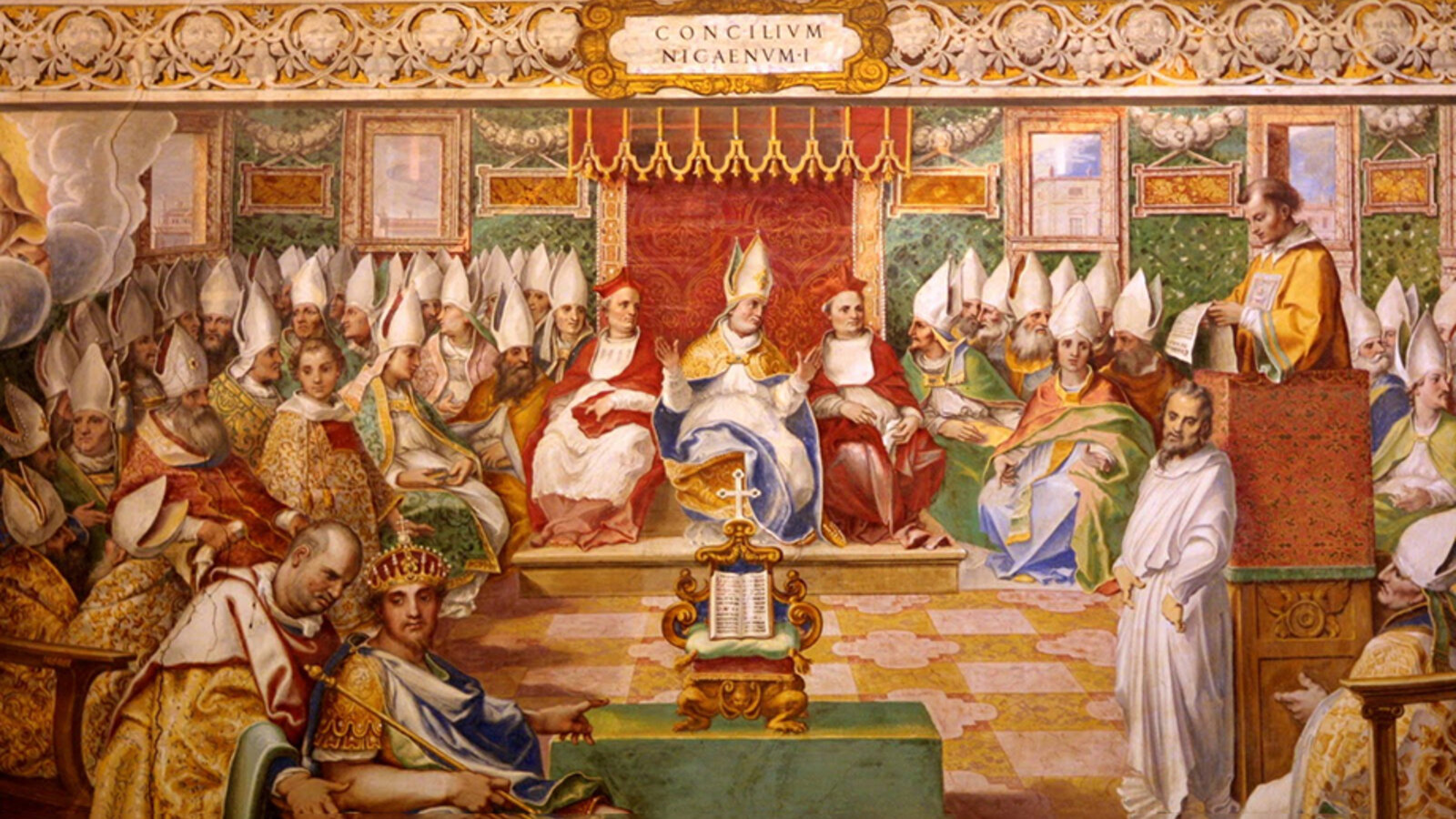
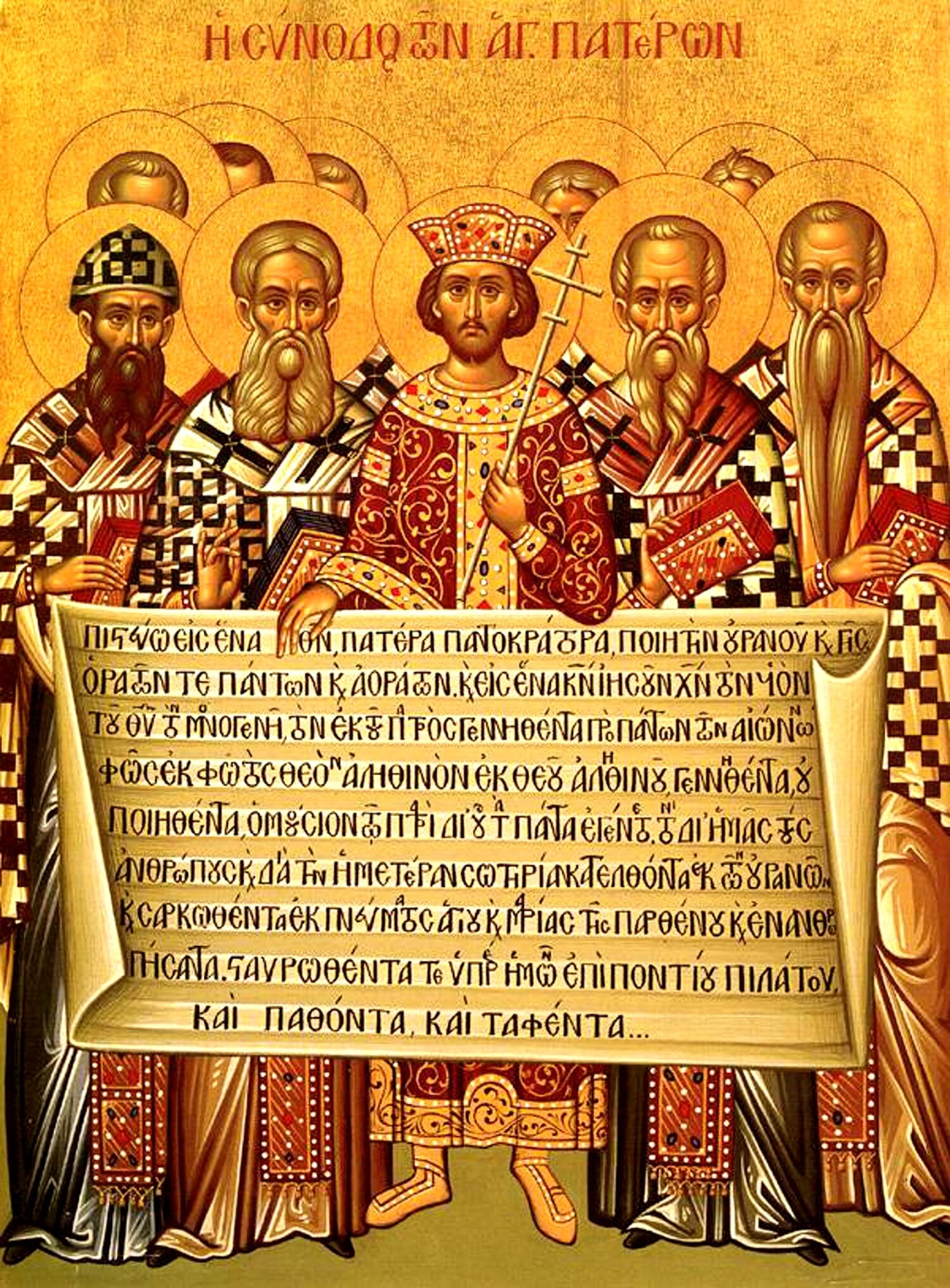
You cannot easily make a pilgrimage to Nicaea; the town is now İznik, a quiet place in Turkey, and the hall of the Council is long gone. But you can stand inside the world the Council belonged to, and that world is Rome. Walk to the Arch of Constantine, beside the Colosseum, raised to the very emperor who summoned the bishops, and you are looking at the monument of the man who made a Christian Council possible. Go to the Basilica of St John Lateran, the cathedral of Rome and “mother of all churches,” built on land Constantine gave to the popes, and you stand on the ground from which the Western Church that carried Nicaea’s Creed was governed for a millennium. Pray beneath the dome of St Peter’s, whose first basilica Constantine raised, and you are in the church that more than any other has professed and defended that Creed ever since. And the great fresco at the head of this article, the one labelled simply Concilium Nicaenum I, hangs not in Turkey but in the Vatican Library in Rome — Rome remembering, in paint, the meeting that gave the faith its words. To understand Nicaea before you go is to walk those Roman places not as ruins and galleries but as the living afterlife of one extraordinary summer. That is the whole idea behind this site: prepare your mind, and a monument becomes a meaning.
Whether you are a pastor planning a journey for your congregation or a traveller going on your own, we build trips through Christian Italy around understanding — so that the Creed you say every Sunday, and the Rome where it took root, become something you grasp rather than merely glimpse. Tell us about your trip and we’ll start planning it with you.
Plan your pilgrimage →Common questions
The First Council of Nicaea, held in 325 AD, was the first gathering of bishops from across the whole Christian Church. Called by the emperor Constantine, it met to resolve the Arian controversy over the divinity of Christ, and it produced the first version of the Nicene Creed.
It declared that Jesus Christ is true God, “of one being” (homoousios) with the Father, rejecting the teaching of Arius that the Son was a created being. It also set a common rule for calculating the date of Easter and issued about twenty canons governing Church discipline.
The Roman emperor Constantine called it in 325 to end the Arian controversy, a dispute over whether Christ was fully God that was dividing the newly legalised Church. He invited bishops from the whole empire and paid for their travel, presiding as host though not as a theologian.
It wrote the original Nicene Creed in 325. The slightly longer version recited at Mass today — with its fuller words on the Holy Spirit and the Church — was completed at the First Council of Constantinople in 381, and is properly called the Niceno-Constantinopolitan Creed.
Nicaea is the ancient name of İznik, a town in north-western Turkey beside a lake. The Council’s hall no longer survives, so there is little to see of the event itself. Its legacy, however, is vivid in Rome, the city of Constantine who convened it and the enduring centre of the faith it defined.
Probably not. Tradition places Nicholas of Myra — the saint behind Santa Claus — at the Council and tells of him striking Arius, but he is absent from the early records and the story is a later legend. It endures because it captures how fiercely the bishops felt the question of Christ’s divinity.