The Shroud of Turin: the Relic and the Evidence
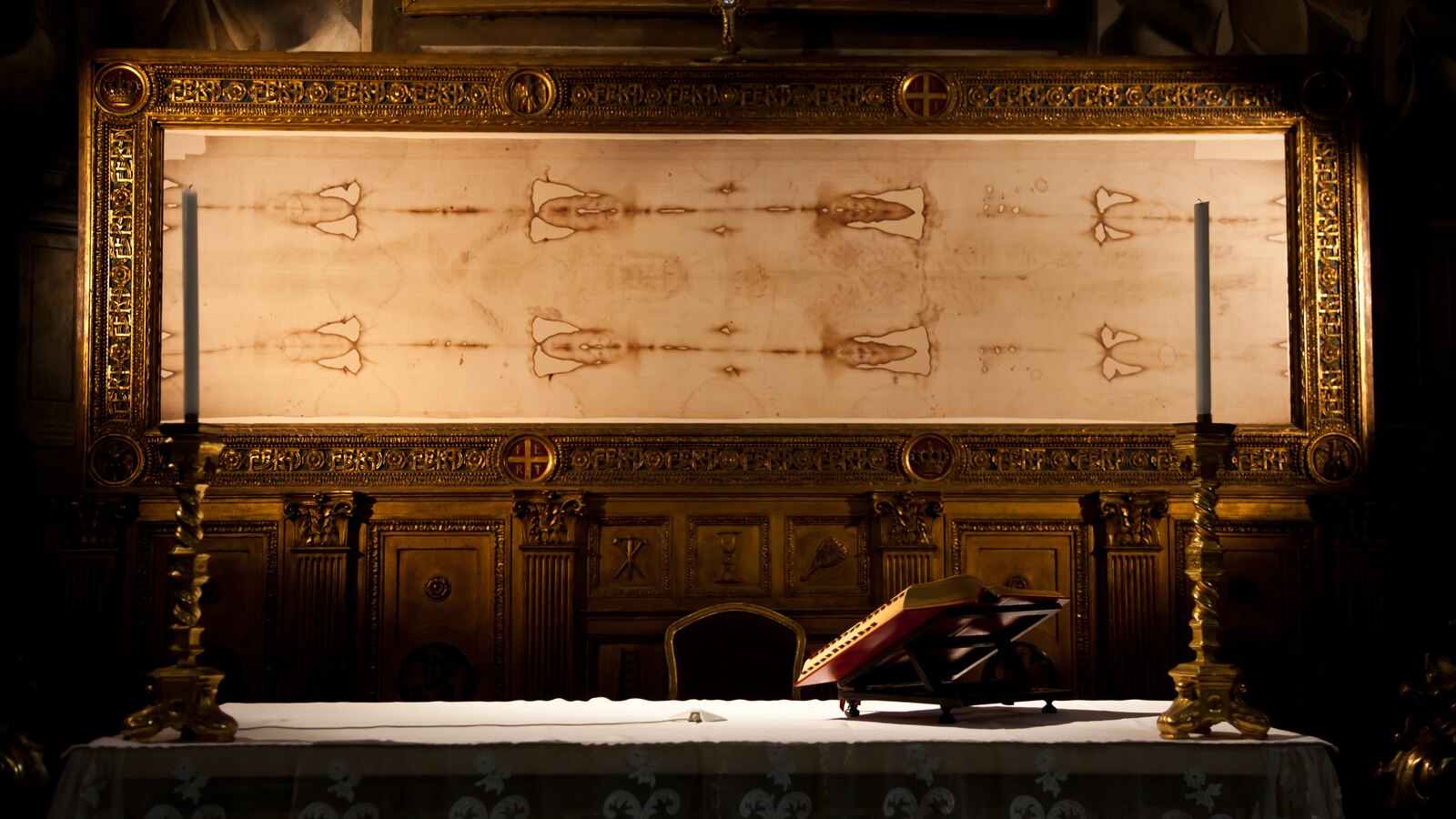
In a chapel behind the high altar of Turin Cathedral, locked inside a climate-controlled case that is opened to the public only once or twice in a generation, lies a strip of old linen a little over four metres long. On it, faint as a watermark, is the full-length image — front and back — of a bearded man who has been scourged, crowned with thorns, nailed through the wrists and feet, and pierced in the side. It is the most studied, most photographed and most fiercely disputed object in the Christian world: the Shroud of Turin, which millions believe to be the burial cloth of Jesus, and which a famous 1988 laboratory test dated to the Middle Ages. Both of those sentences are true at once, and that is exactly why the Shroud is worth understanding rather than merely believing or dismissing.
We write about it here in the spirit this whole site is built on: not to sell you a miracle, and not to debunk one, but to lay out honestly what is known, what is contested, and what the Church itself actually claims — which is far less than most people assume.
What the cloth actually shows
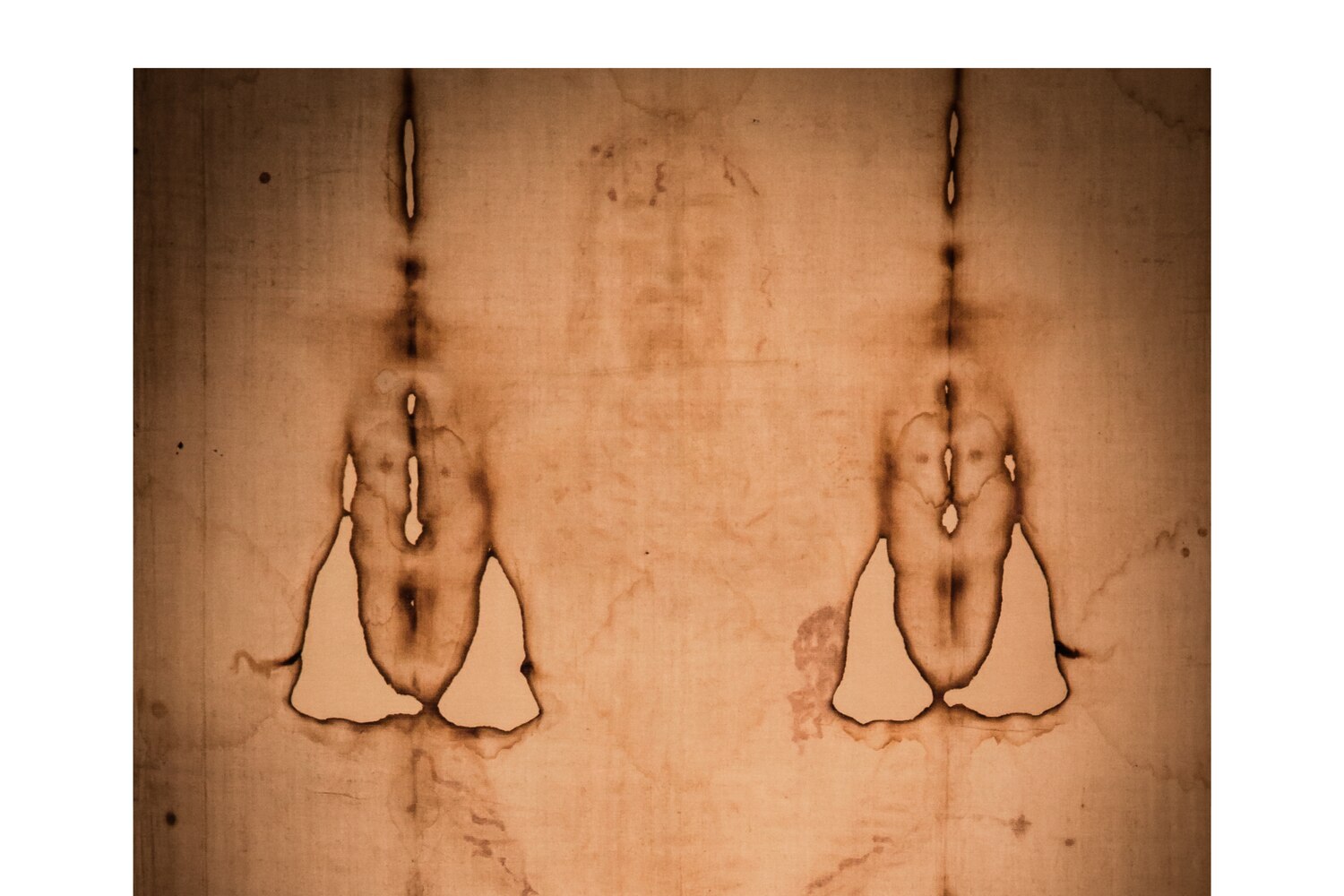
It is a single piece of woven linen, roughly 4.4 metres long and 1.1 metres wide, its threads run in the herringbone twill of a costly ancient cloth, bearing the faint, straw-coloured image of a naked man laid out in death and seen from the front and the back, as though the sheet had been folded lengthwise over the head and down the body. Running the length of it are the scars of its own near-destruction: two parallel lines of burns and a row of diamond-shaped patches, the wounds of a fire it barely survived. For most of its history the image was so dim that visitors struggled to make it out at all. What has kept scientists arguing over it for more than a century is not its beauty but its strangeness, for the closer it is examined the less ordinary it becomes.
It is not a painting in any ordinary sense. There are no brushstrokes, no outlines, no pooled or cracked pigment; the image is astonishingly superficial, resting only on the topmost fibres of each thread, as if the cloth had been lightly scorched by something it cannot have touched. The marks on the body, meanwhile, are anatomically exact in ways a medieval forger would have had no reason to know: the scourge wounds fall in the dumbbell pattern of a Roman flagrum, there are dozens of puncture marks around the whole scalp rather than a neat circlet, and the nails pass through the wrists, not the palms, where alone they could bear the weight of a crucified body — a detail against every medieval painting of the crucifixion. Where the image meets the cloth there are also stains identified as real human blood, reported by the researchers who tested them to be of group AB. None of this proves whose body it was. All of it is why the Shroud has refused, for a hundred years, to be waved away as an obvious fake.
The photograph that made it famous
For most of its known life the Shroud was a dim and unimpressive thing to stand before — a ghost on a sheet. Then, on the night of 28 May 1898, an Italian lawyer and amateur photographer named Secondo Pia was permitted to photograph it for the first time. Developing his heavy glass plates in the dark, he was so startled that he nearly dropped them: on the negative, the faint smudge resolved all at once into a clear, lifelike, almost sculptural human face and body. The Shroud, in other words, behaves like a photographic negative, its lights and darks reversed, centuries before anyone had conceived of photography. That single discovery turned a regional relic into a modern enigma overnight, and it is the reason the face of the Shroud, as the world now knows it, is almost always reproduced from Pia’s reversed plate rather than from the cloth itself.
Thirteen missing centuries
The documented history begins surprisingly late, and this is one of the honest difficulties of the Shroud. It appears in the reliable record only in the 1350s, when it was displayed in the small French town of Lirey by the family of a knight, Geoffroi de Charny. In 1453 it passed to the House of Savoy, the dynasty that would one day rule a united Italy, who kept it at Chambery; and there, on 4 December 1532, a fire in the chapel very nearly destroyed it, molten silver from its reliquary burning through the folded cloth and leaving the symmetrical scorch marks and holes that nuns of the Poor Clares later repaired with the patches still visible today. In 1578 the Savoys carried it to their new capital, Turin, where it has remained ever since, and in 1983 the last of the Savoy line bequeathed it to the Holy See, so that the pope is now its owner and the archbishop of Turin its custodian. What there is no undisputed record of is the thirteen centuries between a burial outside Jerusalem and that first showing at Lirey — a silence that believers fill with tradition and fragments, and that sceptics read as the whole of the story.
The carbon-14 verdict, and why it didn’t settle anything
In 1988 the Church allowed the decisive test. Small samples cut from one corner of the cloth were sent to three independent radiocarbon laboratories — at Oxford, the University of Arizona, and the Swiss Federal Institute in Zurich. Their answer was unanimous and, to many, devastating: with 95 per cent confidence, the flax of the linen had grown between roughly 1260 and 1390 AD, the Middle Ages, neatly bracketing the cloth’s first appearance at Lirey. The archbishop of Turin announced the result that October, and by the ordinary standards of science the matter looked closed: a medieval cloth, and therefore not the shroud of Jesus.
And yet it did not close, for reasons worth stating fairly. Critics pointed out that the single sampled corner was precisely the part of the Shroud most likely to have been handled, patched and contaminated over six centuries — gripped by countless hands at public showings, mended after the fire, possibly rewoven with newer thread — and therefore the least representative scrap of the whole. The laboratories have consistently defended their work, and most radiocarbon specialists still regard the 1988 result as sound; but the debate has never fully died, and later studies have pulled in both directions. Standing behind all of it is the harder puzzle no test has resolved: no one has been able to say how the image was made. Medieval forgery, scorch, a chemical reaction, something stranger — every explanation offered has left serious investigators unsatisfied. The result is a genuine stalemate, and the honest position is to name it as one rather than to pretend that either side has won.
A medieval date on a cloth bearing an image no one can explain: the honest answer is that the question is still open.
The other shroud: the Sudarium of Oviedo
Few visitors know that Turin’s cloth has a quieter companion. In the cathedral of Oviedo, in the north of Spain, is kept the Sudarium — a bloodstained linen about the size of a hand-towel, bearing no image at all, which tradition holds to be the separate face-cloth laid over Jesus’s head, the one the Gospel of John describes as folded apart in the empty tomb. Unlike the Shroud, its record reaches back much further: it is documented in Spain from around 840 AD, centuries before the Shroud surfaces at Lirey. Researchers who believe both cloths are genuine argue that the two corroborate each other — that the bloodstains on the Sudarium align with the wounds on the Shroud’s face, and that the blood on both is of the same rare group, AB. It is a striking claim, and an honest account must add the other half of it: those correspondence studies come largely from scholars already persuaded of authenticity and have not been independently replicated, and the Sudarium’s own radiocarbon dating points only to the seventh or eighth century, no closer to the first than Turin’s. Two cloths, two mysteries, leaning on each other — fascinating, and still unproven.
What the Church actually says
Here is the detail that surprises almost everyone, and that we think matters most. The Catholic Church has never declared the Shroud to be the authentic burial cloth of Jesus, and it does not ask anyone to believe that it is. Its official position is one of studied neutrality: it neither affirms nor denies the Shroud’s authenticity, and it entrusts the question of origins to science. What it permits, and warmly encourages, is veneration of the cloth as an icon — a powerful image that draws the mind to the suffering and death of Christ, whether or not the linen itself ever wrapped him. As Pope John Paul II put it, the Church leaves to scientists the task of continuing to investigate. That restraint is not weakness but the same careful weighing we saw when Rome spent decades doubting Padre Pio before accepting him: the faith does not need the Shroud to be real, and it is honest enough to say that it is simply not sure.
Why a disputed relic belongs on a pilgrimage
You might expect a site that plans journeys of faith to insist the Shroud is genuine. We do the opposite, and on purpose, because the Shroud is the single best place in Italy to feel how faith and modern science actually meet — not as enemies, but as two serious ways of questioning the same object, neither able to dismiss the other. That is a far more interesting thing to stand in front of than a settled miracle. On this site we say that the point of preparing for a pilgrimage is to understand, not merely to look, and the Shroud is the proof of why: walk into that chapel believing nothing and you see a faded sheet, but walk in understanding the photograph, the fire, the carbon test, the unexplained image, the cloth in Oviedo and the Church’s own honest doubt, and you are standing before one of the great open questions of the modern world, which is its own kind of holy ground. It is the same preparation we bring to the Eucharistic miracles catalogued by Carlo Acutis, and the same clear sight behind our whole idea of pilgrimage over tourism: prepare your heart, and your head, not just your suitcase.
Seeing it in Turin
The Shroud lives in the Cathedral of St John the Baptist in Turin, the elegant and under-visited former capital of Savoy in the north-west of Italy, under the Alps. Be clear on one thing before you build a trip around it: the cloth itself is almost never on view. It is kept sealed and is brought out for public display — an ostension — only on rare, specially announced occasions, often more than a decade apart, and the crowds when it happens are immense. Outside those rare showings you cannot see the Shroud, but you can stand in the chapel behind the cathedral’s altar where it rests, and you can visit the excellent Museum of the Shroud, which tells the scientific and historical story in full and displays a faithful full-size copy. Turin itself — its arcaded boulevards and grand cafes, its Egyptian Museum second only to Cairo’s, its backdrop of white Alps — richly repays the journey whether or not the cloth is showing. Plan a Shroud pilgrimage around a confirmed ostension if you possibly can; otherwise come for the city and the story, and let the chapel do its quiet work.
Whether you are a pastor planning a trip for your congregation or a traveller going on your own, we build journeys through Christian Italy around understanding — so that a place like Turin, and an object like the Shroud, becomes a question worth standing in front of rather than a box to tick. Tell us about your trip and we’ll start planning it with you — and watch for the next ostension.
Plan your pilgrimage →Common questions
A linen cloth, about 4.4 metres long, kept in Turin Cathedral, bearing the faint front-and-back image of a crucified man with wounds matching the Gospel account. Many believe it is the burial cloth of Jesus; it is the most studied and most disputed relic in Christianity.
It is genuinely unresolved. A 1988 radiocarbon test dated the linen to about 1260–1390 AD, suggesting a medieval origin, but critics question the sample, and no one has explained how the image was formed. The honest answer is that the question remains open.
In 1988 three laboratories — Oxford, Arizona and Zurich — dated the flax to roughly 1260–1390 AD with 95 per cent confidence. The labs stand by the result; sceptics argue the sampled corner was repaired or contaminated and not representative of the whole cloth.
No. The Church takes no official position on whether it is the burial cloth of Jesus. It neither affirms nor denies its authenticity and leaves that to science, while encouraging the faithful to venerate it as an icon of Christ’s Passion.
Only rarely. The cloth is normally sealed away and displayed publicly — an “ostension” — just once or twice a generation, on announced occasions. The rest of the time you can visit its chapel in Turin Cathedral and the Museum of the Shroud, which shows a faithful copy.
It appears in the record at Lirey, France, in the 1350s, passed to the House of Savoy in 1453, survived a fire at Chambery in 1532, and was moved to Turin in 1578 when it became the Savoy capital. It has stayed there since; the Holy See has owned it since 1983.