Our Lady of Good Counsel: the Miracle of Genazzano
In a hill town an hour’s drive east of Rome, on the afternoon of the 25th of April 1467, a crowd gathered at a festival heard sudden music in the air, saw a cloud settle against the wall of a half-built church — and when it lifted, found there a delicate painted image of the Madonna and her Child that no human hand had placed. Or so the people of Genazzano have told it for more than five hundred years. The fragile fresco they call the Madonna del Buon Consiglio, Our Lady of Good Counsel, has hung there against all the laws of nature ever since: a thin flake of painted plaster, barely attached to the wall, that has survived earthquakes, war and the passing of centuries, and that drew to itself the devotion of popes and the love of ordinary Italians. This is the story of the miracle of Genazzano — the legend of an image that flew across the sea, the fragile painting at the heart of it, and the gentle Mother to whom the troubled have turned for counsel ever since. It is one of the most touching, and least known, holy places within easy reach of Rome.
The town and the unfinished church
Genazzano is an old hill town in the Prenestini mountains of Lazio, south-east of Rome, the kind of place travellers pass without a glance on their way to grander sights. In the fifteenth century it had an ancient and crumbling church, Santa Maria, in the care of the Augustinian friars, and by the 1460s it was falling down. A devout local widow named Petruccia had given her whole fortune to begin rebuilding it, convinced that the Mother of God wished it so — but the money ran out with the walls raised only a little way, and the half-finished church stood open to the sky, a monument, the townspeople muttered, to an old woman’s foolishness. Petruccia only answered that before she died she would see a great wonder worked there. She was mocked for it, by every account — a poor widow who had poured out everything she owned on a ruin, promising marvels while the roofless walls filled with weeds and the townspeople shook their heads. But she held to her strange certainty, and her stubborn faith has become inseparable from the story ever since: the reminder that the wonder, when it finally came, came first of all to the one person in Genazzano who had never once stopped expecting it. It is against this background of an abandoned building site and a mocked old woman’s faith that the people of Genazzano set the events of that April day.
The day the image appeared
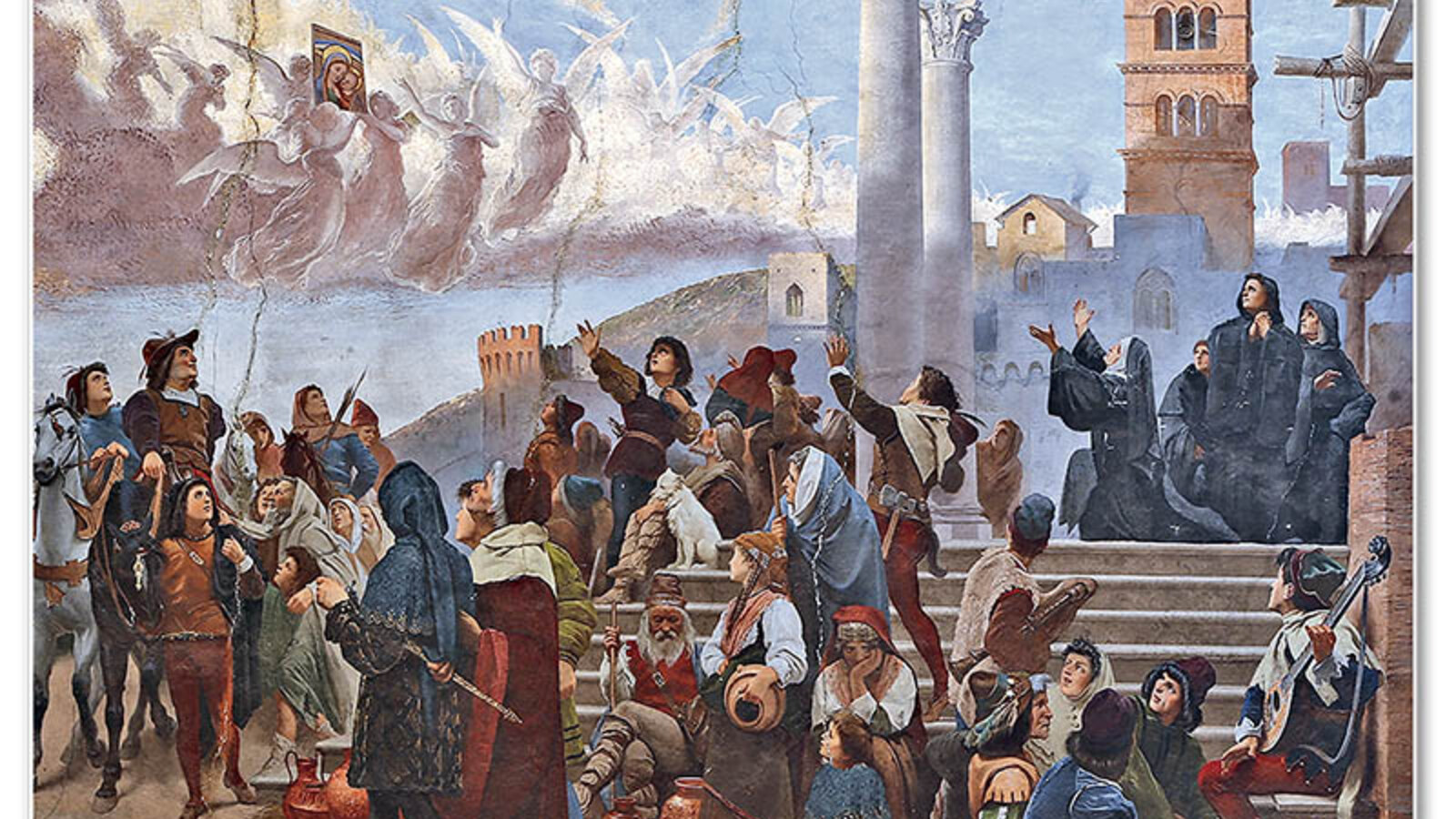
The 25th of April was a feast day, and the town was crowded and festive when, in the late afternoon, those present reported hearing strains of unearthly music and seeing a glowing cloud descend upon the unfinished wall of the church. As the whole town ran to look, the cloud dissolved — and revealed, fixed to the rough plaster of a wall where nothing had been before, a small and exquisite painted image of the Virgin Mary cheek to cheek with the child Jesus. The bells of the town, it was said, began to ring of their own accord, and other bells across the region answered them. In the days that followed, as word spread, pilgrims poured into Genazzano, and the friars began at once to record the healings and graces reported before the image — a register of wonders that, remarkably, has been kept at the shrine in an almost unbroken series from that year to this — one of the oldest continuous records of popular devotion anywhere in Italy. Within days, the chroniclers add, two weary travellers from across the Adriatic arrived in the town, took one look at the image on the wall and fell to their knees, declaring that they had followed it all the way from their own country. The old widow Petruccia had her miracle; and the half-built church, far from being an embarrassment, became one of the most visited sanctuaries in the hills of Rome.
The cloud dissolved, and revealed an image that no human hand had placed there.
The flight from Scutari
But where had the image come from? The answer the people of Genazzano gave is one of the most romantic legends in all of Marian devotion, and it reaches far across the sea. At that very time, on the far shore of the Adriatic, the Christian land of Albania was being overwhelmed by the advancing armies of the Ottoman Turks, and its churches faced destruction. For a quarter of a century the Albanians had held out against the whole might of the Ottoman Empire under their national hero, Gjergj Kastrioti, called Skanderbeg; but his long resistance was ending, and with it the freedom of his people, and the land lay open at last to conquest. In the Albanian city of Scutari — today Shkodër — there was a beloved and ancient image of the Madonna, and as the invaders closed in, the story goes, it detached itself from the wall of its church, wrapped itself in a cloud, and was carried through the air westward over the sea. Two Albanian pilgrims, devoted to the image, are said to have followed the cloud on its journey across land and water until they lost sight of it near Rome — and found it, at last, on the wall at Genazzano. The people of Scutari, the legend adds, later found only the bare outline on their own church wall where their Madonna had been. It is a tale the Augustinian chroniclers set down within a generation, and whether one receives it as history or as holy poetry, it carried for centuries a real and poignant meaning: that as one Christian land fell to conquest, its Mother came to find a home among those who would still honour her.
The fragile fresco
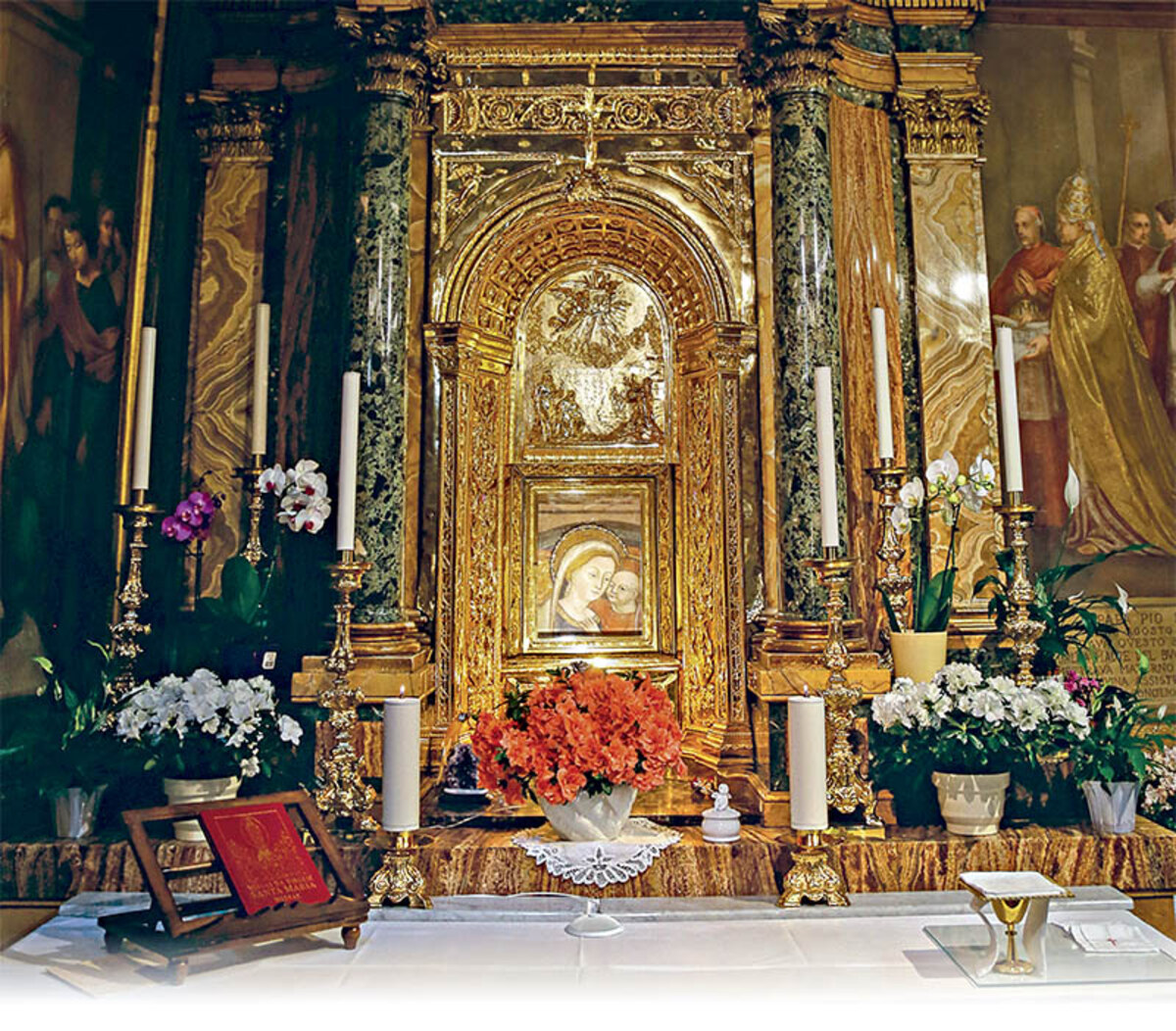
Strip away the legend and the image itself remains a genuine marvel, and the friars who guard it will tell you so. The fresco is tiny, no larger than a sheet of paper, a tender half-length of the Virgin and Child in the sweet manner of the fifteenth century, their faces pressed close together in an attitude of infinite gentleness. What has astonished every observer for five hundred years is its physical condition: the painted layer is extraordinarily thin and, by all accounts, barely adheres to the wall at all — so delicate that it seems it should long ago have crumbled to dust, and so apparently unsupported that pilgrims speak of it as standing “without a wall behind it.” That a flake of painted plaster this fragile should have survived intact through earthquakes that shook the region, through the bombing of the Second World War that damaged the very church around it, and through the touch of countless centuries of veneration, is for the faithful a quiet continuing miracle, more persuasive than any legend of flight. The sober historian may suspect that an older fresco was simply uncovered on a wall long hidden under plaster; the pilgrim who stands before it sees only a Mother whose face has outlasted empires. Both can agree that the little painting of Genazzano is a thing of uncommon tenderness and uncommon endurance. The Church gave the image its highest honour long ago: in 1682 the Vatican Chapter crowned it, the solemn act by which Rome recognises the most venerated images of the Madonna, and the fresco has been examined, restored and guarded with the greatest care ever since — always with the same caution, for the slightest rough handling might be the end of so fragile a thing. That it is still there at all, a breath of paint that has outlasted five centuries, is the heart of why people come.
Mother of Good Counsel
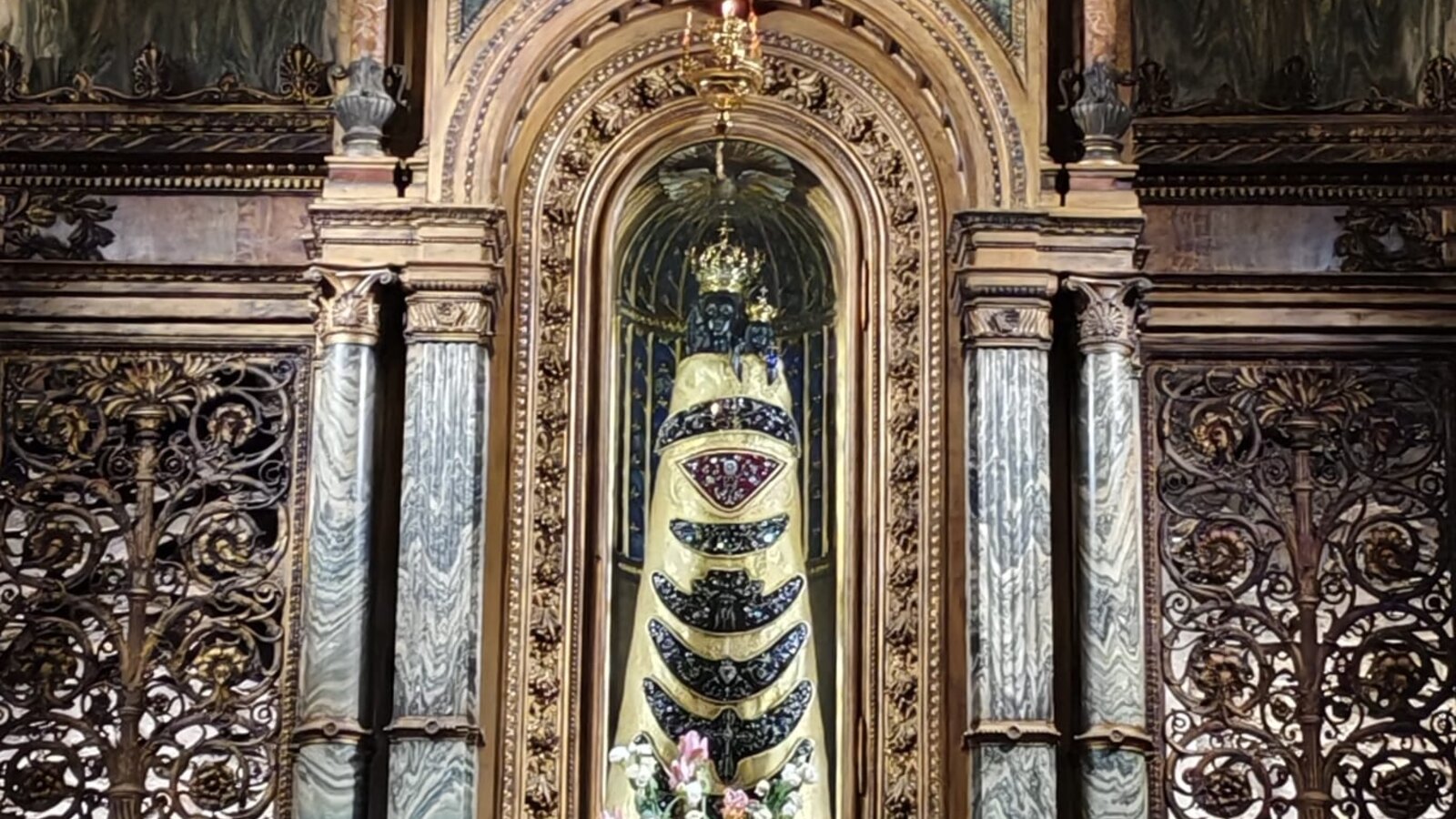
The title the image carries — Mater Boni Consilii, Mother of Good Counsel — is one of the most beautiful in all the many names of Mary, and it names exactly what the troubled have sought at Genazzano for five centuries: not a cure or a fortune, but counsel, the wisdom to know what to do. It is a very human grace to ask for, and a very Augustinian one; the old prayer carried beneath her image puts it with perfect simplicity — Mater boni consilii, ora pro nobis, Mother of Good Counsel, pray for us — and for generations of Italians standing at the ordinary crossroads of a life, that short petition has been enough. People have climbed to this shrine at the crossroads of their lives — before a marriage, a vocation, a grave decision, a loss — to lay their confusion before a Mother believed to be especially ready with guidance. The devotion spread across the Catholic world through the Augustinian order that has always guarded the shrine, and it found its greatest champion in Pope Leo XIII, who loved Our Lady of Good Counsel above almost any devotion, approved and promoted her veneration, and in 1903, in the last year of his long life, inserted the invocation “Mother of Good Counsel” into the Litany of Loreto, the great list of Mary’s titles recited by Catholics around the world to this day. Through that single act a fragile fresco in a small Italian town joined the universal prayer of the Church. Churches, colleges and whole parishes from the Americas to the Philippines now bear her name, and her image — the two faces pressed close in that fifteenth-century tenderness — hangs in countless homes across the Catholic world; yet the original remains exactly where it first appeared, a small bright window of paint in a wall at Genazzano, drawing to itself the devotion it has never lost.
The popes who loved her
Few shrines of its modest size have been so cherished by the popes. The devotion to Our Lady of Good Counsel grew steadily through the centuries, carried across the world by the Augustinians, and one pope after another took the little Madonna of Genazzano to heart. It was Leo XIII, one of the longest-reigning and most learned popes of the modern age, who loved her most of all: devoted to her since childhood, he added her name to the Litany of Loreto, approved prayers and a scapular in her honour, and spoke of her as the guide of his own difficult pontificate. In our own time, Pope John XXIII — the beloved “Good Pope John” — made one of his first journeys outside Rome a pilgrimage to Genazzano, in 1959, kneeling before the fresco as a simple pilgrim. That a painting on a village wall should have drawn the heirs of Saint Peter to their knees before it tells you something of the quiet authority this gentle image has held over the Catholic imagination for five hundred years.
An Augustinian shrine near Rome
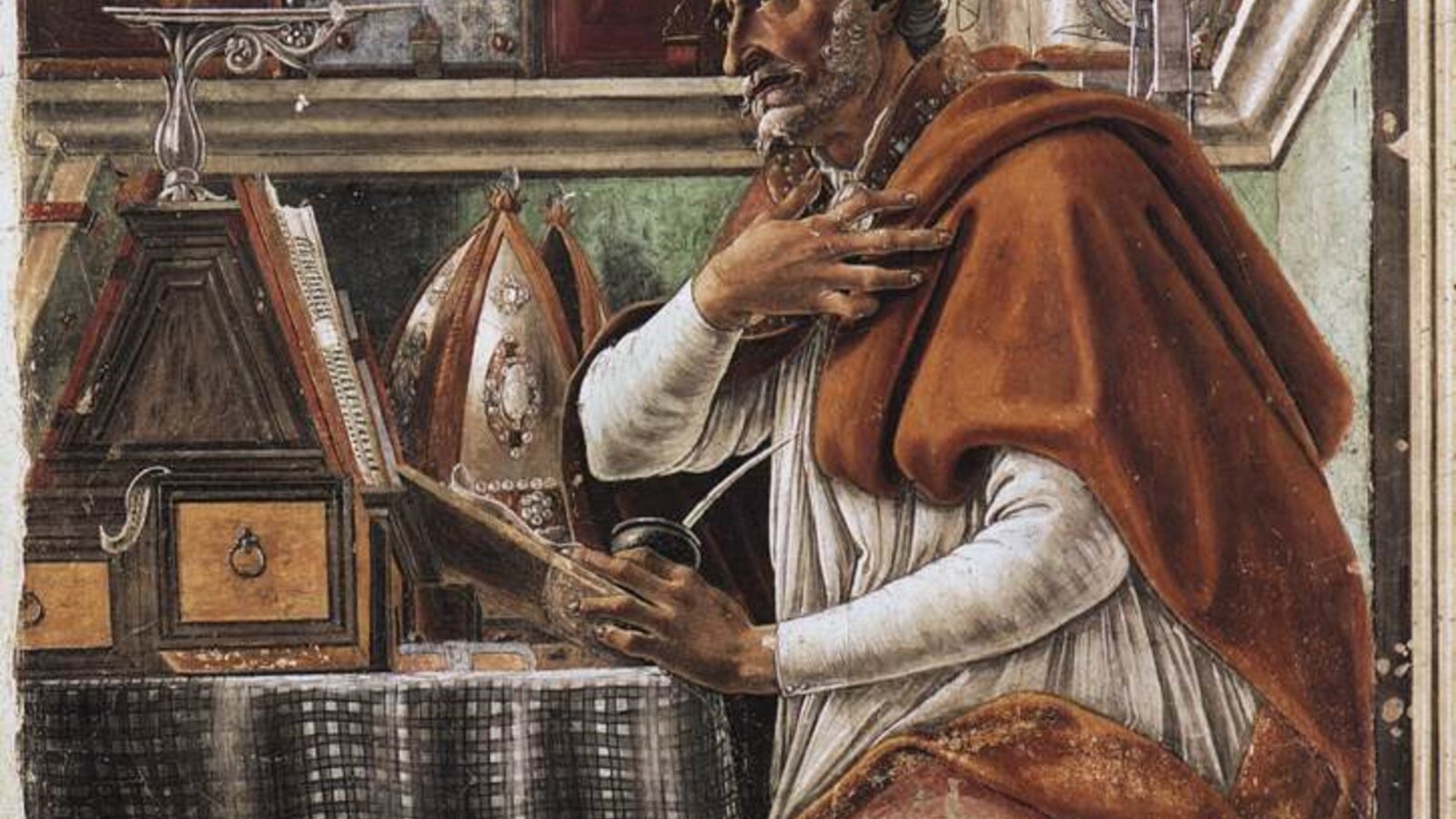
It is no accident that this is an Augustinian sanctuary, for the friars who have kept it for over five centuries follow the Rule of Saint Augustine himself — and there is a fitting harmony in the fact that the great Doctor who wrote so searchingly of the restless heart’s need for guidance should watch, through his sons, over a shrine dedicated to counsel. The sanctuary of Genazzano sits within easy reach of Rome, among the green hills and old towns of the Prenestini and the nearby Castelli Romani, a world away in spirit from the crowds of the capital. It has drawn pilgrims steadily for five hundred years, and in that time the simple half-built church of the mocked old widow has grown into a basilica, its register of graces still being written. For the traveller willing to leave the well-worn path, it offers something the great basilicas of Rome cannot: a living local miracle, guarded quietly in the hills, where the faith is not a monument to be admired but a devotion still warm in the hands of the people who keep it.
Why she still draws the troubled
Of all the many images of the Virgin in Italy, the Madonna of Genazzano speaks to a very particular human need, and it is one that has not changed in five centuries. People do not come to her chiefly for the spectacular — for a cure or a sign — but for something quieter and, in its way, harder: the wisdom to choose well. Hers is the Mother invoked by the young man uncertain of his path, the couple on the edge of a decision, the parent at a loss, the soul tangled in a problem it cannot think its way out of. “Good counsel” is the oldest and most practical of graces, and there is something deeply moving in the sight of a shrine where, for half a millennium, ordinary people have come not to demand a miracle but simply to ask what they should do. In an age that drowns in information and starves for wisdom, the Mother of Good Counsel may be more quietly relevant than ever — which is perhaps why her little sanctuary in the hills has never emptied, and why it still rewards the traveller who seeks it out.
Visiting Genazzano
Genazzano lies about fifty kilometres east of Rome, an easy drive or a modest train and bus journey into the hill country beyond the city, and it makes a rewarding half-day away from the capital for anyone drawn to the quieter corners of Christian Italy. The Sanctuary of Our Lady of Good Counsel stands at the heart of the old town, and the fragile fresco can be seen enshrined in gold above its altar, still the object of unbroken devotion; the town itself, with its castle of the Colonna princes and its steep medieval lanes, repays an unhurried wander. It pairs naturally with the other Marian and Augustinian places of the region, and with the hill towns and vineyards of the Castelli Romani just to the west. To come here knowing the story — the ruined church, the widow’s faith, the cloud from Albania, the painting that will not fall — is to turn a quiet country shrine into one of the most touching stops in all of pilgrim Italy: proof that the great story of the faith is written not only in Rome’s mighty basilicas but on a flake of plaster in a little town in the hills. It is exactly the kind of place that gives a journey through Christian Italy its depth: a stop that few tourists ever make, where an old wonder is still tended by the people who have loved it longest, and where the question the whole shrine answers — what should I do? — is the oldest and most human prayer of all.
Whether you are a pastor planning a journey for your congregation or a traveller going on your own, we build trips through Christian Italy around understanding — so that a hidden shrine like Genazzano becomes a living encounter with a five-hundred-year-old miracle rather than a dot on a map. Tell us about your trip and we’ll start planning it with you.
Plan your pilgrimage →Common questions
Our Lady of Good Counsel (Mater Boni Consilii) is a title of the Virgin Mary attached to a small miraculous fresco of the Madonna and Child venerated at Genazzano, near Rome. According to tradition the image appeared there on 25 April 1467, and it has been a major Marian shrine, guarded by the Augustinians, ever since.
On 25 April 1467, as a festival crowd gathered at an unfinished Augustinian church in Genazzano, people reported hearing music and seeing a cloud settle on the wall, which lifted to reveal a delicate fresco of the Madonna that no one had painted. Legend holds the image had flown there from Scutari in Albania to escape the Ottoman invasion.
In the Sanctuary of Our Lady of Good Counsel in Genazzano, a hill town about fifty kilometres east of Rome, in Lazio. The fragile fresco is enshrined in gold above the main altar of the basilica, which has been in the care of the Augustinian friars since the fifteenth century.
Besides the legend of its sudden appearance, the fresco is a wafer-thin layer of painted plaster that seems barely attached to the wall, yet it has survived earthquakes, wartime bombing and centuries of veneration intact. Many see its endurance, more than the legend, as a continuing wonder.
It is a title invoking Mary as a giver of wise guidance — counsel — to those facing difficult decisions. Pilgrims come to Genazzano to seek her help at the crossroads of life. Pope Leo XIII, devoted to the title, added “Mother of Good Counsel” to the Litany of Loreto in 1903.
Yes. Genazzano is an easy half-day trip east of Rome, and the Sanctuary of Our Lady of Good Counsel in the old town can be visited, with the miraculous fresco enshrined above its altar. The medieval town and the nearby Castelli Romani make it a rewarding escape from the city.