St Benedict: the Father of Western Monasticism
Around the year 500, as the Roman Empire in the West was collapsing into chaos, a serious young student from the hills of central Italy took one look at the vice and violence of the great city and walked away from it — out of Rome, up into the mountains, and into a cave. He wanted nothing but to be alone with God. What he founded instead, almost by accident, would outlast the empire he fled, shape the next thousand years of European life, and earn him a title the Church still gives him: Saint Benedict, the Father of Western Monasticism. His name is known to millions who could not tell you a single thing he did, and his quiet invention — a balanced daily rhythm of prayer, work and study, lived in community under a wise and humane rule — became one of the most influential ideas in the history of the West. This is the story of the man, the cave, the Rule, and the three places in Italy where you can still stand in his footsteps.
The young man who fled Rome
Benedict was born around 480 in Nursia — today Norcia, a small walled town in the green mountains of Umbria — into a world that was falling apart. The last Western emperor had been deposed only a few years earlier, Italy was ruled by Gothic kings, and the old order was dissolving into insecurity and decay. His family, comfortable enough, sent him as a young man to Rome to complete his education in the liberal arts. But the Rome he found appalled him. It was a city in moral ruin, and the dissolute lives of his fellow students repelled him so deeply that he abandoned his studies, left the city, and resolved to seek God far from its corruption. Almost everything Benedict later built began in that first refusal — a young man’s decision that the glittering, failing world was not worth his soul. The Rome he walked into was a city haunted by its own greatness: sacked twice within living memory, its population collapsed, its monuments decaying, its ruling class clinging to pleasure as the lights went out across the empire. To a devout young provincial it must have looked like the very picture of a civilisation dying of its own excess. He did not stay to try to reform it; he fled it — and in fleeing, without the faintest idea that he was doing so, he began to build the thing that would one day take its place.
Three years in a cave at Subiaco
He made his way into the wild hills east of Rome, to a rugged valley above the ruins of one of Nero’s villas, at a place called Subiaco. There, in a narrow cave in the cliff face — the Sacro Speco, the Holy Cave, still shown to visitors today — he lived as a hermit for about three years, utterly alone. A monk from a nearby monastery, named Romanus, kept his secret and kept him alive, lowering bread to him on a rope down the rock with a little bell attached to warn him it was coming. Benedict spoke to no one and was all but forgotten by the world; and in that solitude, tradition holds, he wrestled his own temptations into submission and grew into the serene master he would become. But a holiness like that cannot stay hidden. Shepherds found him, word spread, and men began to come to him wanting to live as he lived. In time he organised his growing followers into twelve small monasteries scattered through the valley, each of twelve monks with a superior, with Benedict as the father of them all — the first rough sketch of everything that was to come. It was not all peaceful: Gregory the Great records that a group of jealous local monks, who had rashly begged Benedict to lead them, so resented his discipline that they tried to poison his wine — and that when he made the sign of the cross over the cup, it shattered in pieces. The broken cup, and a raven, remain his emblems to this day.
Monte Cassino and the Rule
Around 529 Benedict left Subiaco and travelled south to a commanding hilltop halfway between Rome and Naples, crowned by an ancient grove still sacred to the god Apollo. There, on the summit of Monte Cassino, he threw down the last pagan altar, and in its place raised the monastery that would become the mother house of Western monasticism and one of the most famous abbeys on earth. Gregory records that Benedict, with the clear sight attributed to him, foretold that this great house would one day be destroyed — a prophecy grimly fulfilled more than once in the centuries to come, by Lombard raiders, by Saracen fire, by earthquake, and most terribly of all in our own age. Each time it rose again, and that stubborn rhythm of ruin and rebuilding would become part of the very meaning of Monte Cassino. And there, in his last years, he wrote the short book that was his true life’s work: the Rule of St Benedict, a slim manual of about seventy-three brief chapters setting out how a community of monks should pray, work, eat, sleep, govern itself and treat one another. Its pages lay down the shape of a monk’s whole day — the round of communal prayer at fixed hours that Benedict called the Opus Dei, the “work of God,” woven through hours of manual labour and the slow, prayerful reading of Scripture — together with a long and famous meditation on humility, climbed like the twelve rungs of a ladder toward God. It insists, too, on a startling generosity to outsiders: every guest who comes to the door, the Rule commands, is to be received and honoured “as Christ himself.” He did not set out to change history. He set out to write, in his own modest words, “a little rule for beginners.” It became the blueprint for Christian monastic life across the whole of Western Europe.
He set out to write, in his own words, “a little rule for beginners.” It became the blueprint of Western monasticism.The Rule of St Benedict
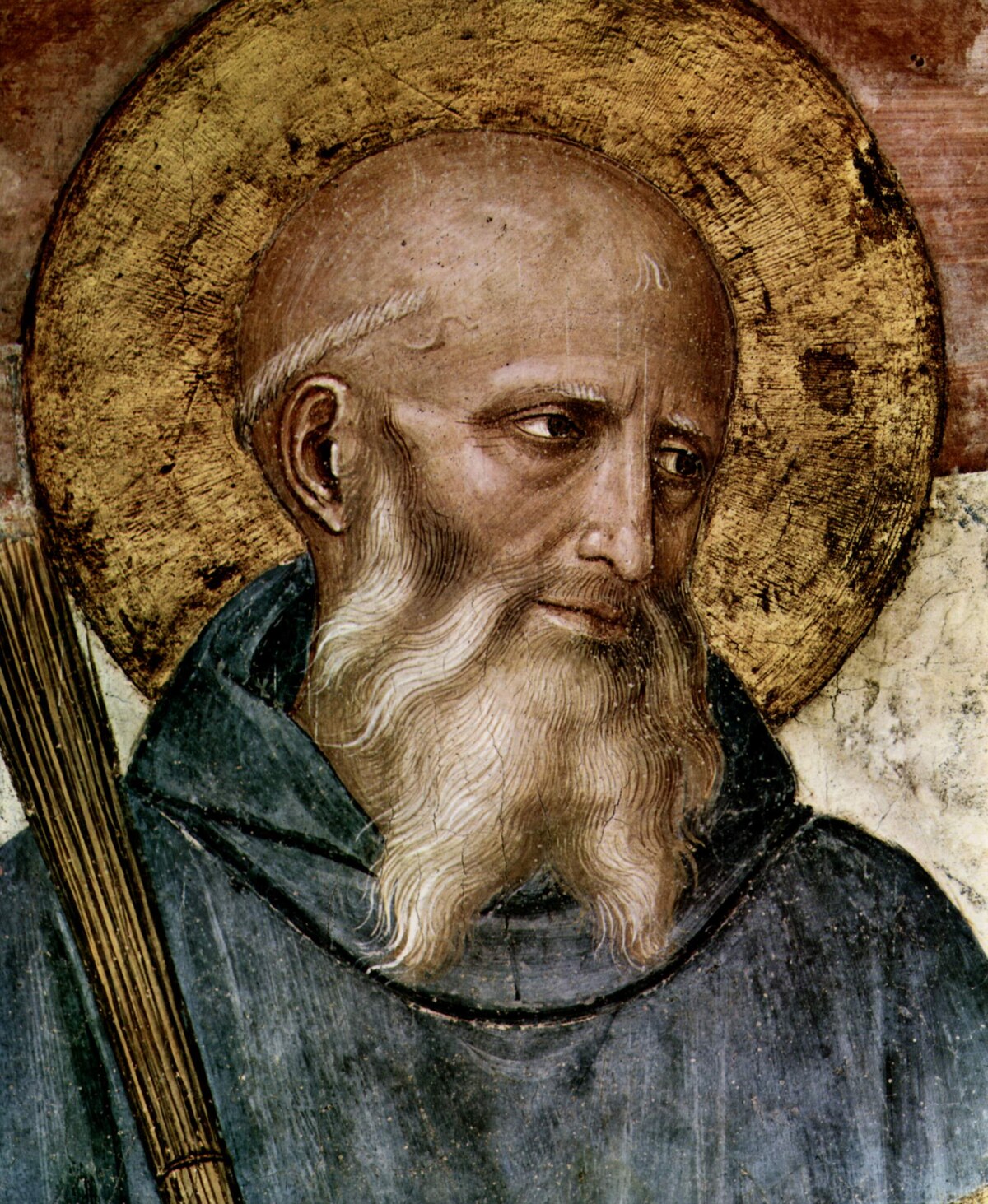
A rule that built Europe
The genius of Benedict’s Rule lies in its balance and its humanity. Against the heroic, punishing extremes of the earlier desert hermits — who outdid one another in fasting and self-torment — Benedict prescribed moderation: enough food, enough sleep, work that was real but not crushing, and a father-abbot bound to lead with discretion and mercy rather than cruelty. Its most famous summary, though the exact phrase came later, is “ora et labora” — pray and work — and its daily rhythm divided a monk’s hours between the communal prayer of the Divine Office, manual labour in the fields and workshops, and the slow reading of sacred texts. To these Benedict added his two quiet revolutions: stability, the vow that bound a monk to one community for life rather than letting him wander, and humble obedience within a settled family. It sounds unremarkable, and that is exactly why it worked. In the centuries of upheaval that followed the fall of Rome, the self-sufficient, stable, literate Benedictine monastery became one of the few fixed points in a broken continent. Monks cleared forests and drained marshes, preserved and copied by hand the manuscripts of the ancient world that would otherwise have been lost, taught, farmed, healed and prayed — and in doing so carried the learning and faith of Europe through its darkest centuries. It is no exaggeration to say that the libraries, the fields and much of the civilisation of medieval Europe were built on the quiet pattern Benedict set down. For six centuries his was effectively the only rule in the West: from Monte Cassino the Benedictine life spread to every corner of the continent, from Ireland to Sicily, renewed and reformed in great centres like Cluny, until the map of Europe was studded with the abbeys that farmed its valleys, schooled its children and copied its books. Historians speak, with good reason, of the “Benedictine centuries.” A little rule for beginners had quietly become the backbone of a civilisation.
What we know, and how we know it
Almost everything we know of Benedict’s life comes from a single source: the second book of the Dialogues of Pope Gregory the Great, written around 593, a little over forty years after the saint’s death. Gregory, himself a monk who had followed Benedict’s Rule, set down a life rich in wonders — the shattered cup, bread carried off by a raven at the saint’s command, a lake of water drawn from solid rock, a disciple walked across a lake’s surface, the future foretold. These stories are not a modern biography and were never meant to be; they are devotional, written to show the holiness of the man rather than to document his days, and a careful reader takes them as the Church has always taken the lives of the saints — as portraits in gold leaf rather than photographs. What shines through them, and what is beyond doubt, is the figure of a wise, firm, deeply humane spiritual father, and the Rule he left behind in his own words, which needs no miracle to prove its greatness. The man is best met not in the marvels but in the book. It is worth adding that the hand which preserved his memory belonged to one of the giants of Christian Rome: Gregory the Great, a Roman nobleman who turned his family palace on the Caelian Hill into a monastery, was elected pope in 590, and steered the Church through plague and invasion — the very pope who sent the mission that converted England. That the life of Benedict reaches us through such a man is itself a quiet thread binding the father of Western monasticism to the city of Rome.
Scholastica, and a sister’s last prayer
One of the most tender episodes the Dialogues preserve concerns Benedict’s twin sister, Scholastica, who had consecrated her own life to God and gathered women into the same monastic life not far from Monte Cassino, founding in effect the female branch of the tradition her brother began. Once a year the two were allowed to meet at a house near the abbey to spend a day speaking of God. At what proved to be their last meeting, as evening fell, Scholastica begged her brother to stay longer and talk on through the night of the joys of heaven. Benedict refused: his own Rule required him to sleep within his monastery’s walls. So Scholastica bowed her head upon the table and prayed — and at once a storm of such violence broke over the house that Benedict could not set a foot outside. “God forgive you, sister,” he cried; “what have you done?” “I asked you,” she answered, “and you would not listen; so I asked my God, and he heard me.” They talked until morning. Three days later, from the window of his cell, Benedict saw his sister’s soul leave her body and rise into heaven in the form of a dove, and he had her laid in the tomb he had prepared for himself, so that not even death should divide them. Gregory draws the gentlest of morals: she prevailed, he says, because of the two she loved the more.
Patron of Europe
The measure of Benedict’s importance was made official in our own time. In 1964, Pope Paul VI declared Saint Benedict the Patron of Europe — a recognition that the continent itself, its faith, its learning and its culture, owed a profound debt to the monasteries that grew from his Rule. It was no accident that the pope made the declaration at the newly rebuilt abbey of Monte Cassino, reconsecrated that same year after its destruction in the Second World War, as if to say that what Benedict built could be shattered but never erased. His emblems — the book of the Rule, the broken cup, the raven — appear on the famous Medal of Saint Benedict, worn by Christians the world over as a prayer for protection, its border carrying the initials of a Latin verse against evil. Fifteen centuries after a young man walked out of Rome in disgust, Europe calls him its father.
Why Benedict still speaks
It would be easy to file Benedict away as a figure of the remote past, but his Rule has never stopped being read, and in a restless age it is being discovered again by people who will never wear a habit. Its appeal is the same now as it was fifteen centuries ago: in a world of noise, haste and endless choice, Benedict offers balance — a life ordered between prayer, work and rest, lived at a human pace, rooted in one place and one community rather than scattered across a hundred distractions. His insistence on stability, on staying put and seeing a commitment through, reads almost as a rebuke to a culture that prizes the opposite; his moderation, neither indulgent nor harsh, feels wiser the faster the world spins; and his command to welcome the stranger “as Christ” remains one of the most beautiful lines in all of Christian writing. Modern authors have urged families and whole communities to recover something of his pattern, and Benedictine monasteries across the world still draw visitors hungry for a few days inside that ancient rhythm. The monk who fled a collapsing Rome to save his own soul ended by leaving the West a quiet manual for living well — one that has outlasted empires and still, gently, works.
Three places in Italy to walk in his footsteps
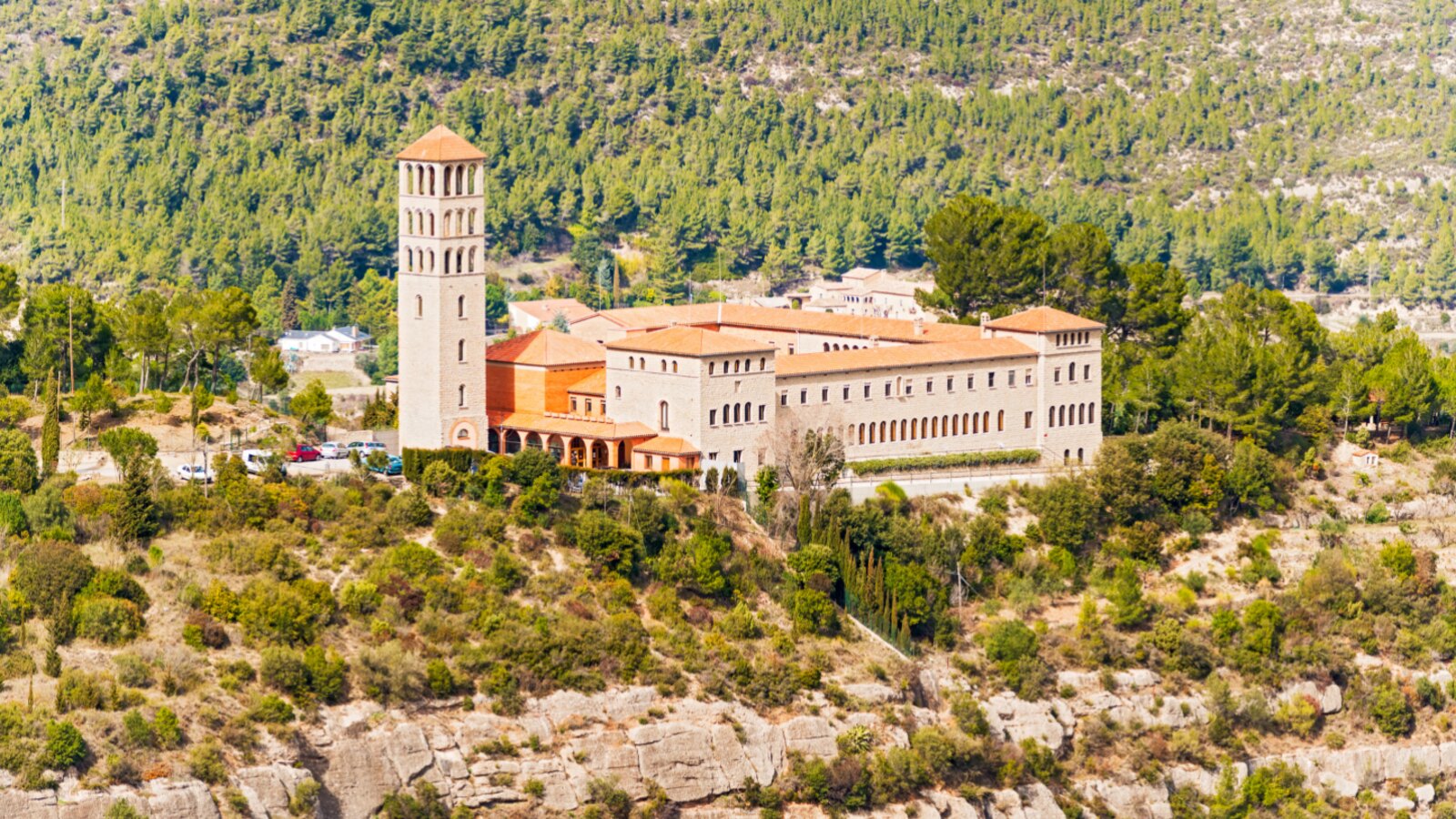
What makes Benedict such a gift for a pilgrim is that his whole story is written across the Italian landscape, in three places you can still visit. It begins at Norcia, his birthplace in the Umbrian mountains, a beautiful walled town that is also, poignantly, a place of loss and rebuilding: the great Basilica of St Benedict that stood over his traditional birth-house was brought down by the central-Italian earthquake of 2016, leaving only its facade, and the work of raising it again goes on. From there the trail leads to Subiaco, east of Rome, where the monastery of the Sacro Speco clings improbably to the sheer cliff around Benedict’s own cave, its walls covered in medieval frescoes — among them one of the earliest known portraits of Saint Francis of Assisi, painted from life. And it ends at Monte Cassino, the vast white abbey on its mountain between Rome and Naples, destroyed in 1944 and rebuilt stone by stone exactly as it was, where the tomb of Benedict and his sister Scholastica lies beneath the high altar. To travel from the cradle at Norcia to the cave at Subiaco to the tomb at Monte Cassino is to follow one of the most complete and moving journeys in all of Christian Italy — the whole arc of a life that changed the world, laid out along the roads you can still drive today.
Whether you are a pastor planning a journey for your congregation or a traveller going on your own, we build trips through Christian Italy around understanding — so that Norcia, Subiaco and Monte Cassino become the living story of the man who shaped Europe, not three names on a map. Tell us about your trip and we’ll start planning it with you.
Plan your pilgrimage →Common questions
Saint Benedict of Nursia (c. 480–547) was an Italian monk who founded the great abbey of Monte Cassino and wrote the Rule of St Benedict, the guide that shaped monastic life across Western Europe. He is honoured as the Father of Western Monasticism and, since 1964, as a Patron of Europe.
It is a short book of about 73 chapters that Benedict wrote for his monks, setting out a balanced daily life of prayer, work and sacred reading — summed up in the motto “ora et labora,” pray and work. Famous for its moderation and humanity, it became the standard rule of Western monasteries.
Because the monasteries founded on his Rule became anchors of stability, learning and faith after the fall of Rome. Benedictine monks preserved ancient manuscripts, cleared and farmed the land, and carried European civilisation through its darkest centuries, which is why Benedict is called the father of Western monasticism.
He was born in Nursia (Norcia) in Umbria, lived as a hermit in a cave at Subiaco east of Rome, and around 529 founded the abbey of Monte Cassino, between Rome and Naples, where he wrote his Rule and died. All three places can still be visited in Italy today.
A devotional medal bearing Benedict’s image with his Rule and a cross, surrounded by the initials of Latin prayers against evil. Long associated with protection and the rejection of temptation, it is one of the most widely worn Christian medals in the world.
Chiefly from the second book of the Dialogues of Pope Gregory the Great, written around 593. It is a devotional account full of miracle stories rather than a modern biography, but it preserves the memory of the saint, and his own Rule survives to show the mind behind it.