Padre Pio: the Friar Who Bore the Wounds of Christ
For fifty years a Capuchin friar in a remote town on an Italian mountain carried open wounds in his hands, his feet and his side — the marks of the crucifixion — and for most of that time hardly anyone in the Church above him knew what to make of it. His name was Padre Pio, and by the time he died in 1968 he had become the most famous, most photographed and most argued-over holy man in modern Italy: investigated and silenced by Rome, adored by millions, accused of fraud and hailed as a living saint, often in the same decade. Today the little town of San Giovanni Rotondo, in the heel of Italy, draws some seven million pilgrims a year — by many counts second only to Guadalupe. To understand why is to understand something about how the oldest claims of the faith kept being made, and tested, deep into the age of cameras and hospitals and the morning paper.
This is not a far-off story. Padre Pio was alive when there were televisions and jet aircraft; there are people still living who confessed their sins to him. If the point of a pilgrimage, as we keep saying on this site, is to understand the world the faith walked into and the thread that runs, unbroken, from it to you, then Padre Pio is one of the places where that thread comes almost close enough to touch.
A frail boy from Pietrelcina
He was born Francesco Forgione on 25 May 1887 in Pietrelcina, a poor farming village in the hills of Campania, south of Rome. His was a devout peasant family; his father emigrated to America to pay for his son’s schooling toward the priesthood. At fifteen the boy entered the Capuchins, the austere branch of the Franciscan order, and took the name Pio. He was ordained a priest on 10 August 1910, at twenty-three. From the start he was physically fragile — racked by fevers and chest complaints that no doctor could quite name, so sickly that for years his superiors kept him at his family home rather than in community. He even did a brief, broken stint in the army medical corps during the First World War, repeatedly discharged as unfit. In 1916 he was sent to a small, isolated friary on the Gargano, the rocky spur that juts into the Adriatic: the convent of Our Lady of Grace at San Giovanni Rotondo. He would remain there, almost without interruption, until the day he died fifty-two years later. Nothing about the setting suggested that the eyes of the world were about to turn to it.
The wounds appear
On the morning of 20 September 1918, Padre Pio was praying alone in the choir loft of the friary church after Mass when, by his own account, he was pierced as if by a figure of light, and found his hands, his feet and his side marked with open, bleeding wounds in the exact places of Christ’s crucifixion. Weeks earlier, in early August, he had described an invisible wounding of the heart — what mystical tradition calls the transverberation. Now the marks were visible, and they did not go away. He carried them, bleeding, for the next half-century: the first priest in the recorded history of the Church to bear the stigmata.
What makes his case unlike the medieval stories of wounded saints is that it unfolded under the full glare of the modern world. Doctors were sent to examine him — some believing, some frankly hostile — and they measured, photographed and argued. The wounds bled, gave off what many described as a scent of flowers, and resisted both healing and infection for decades; sceptics countered that they could be self-inflicted or kept open with acid, a charge never proven and fiercely denied. Padre Pio himself found the attention an agony. He wore brown half-gloves to cover his hands and spoke of the wounds as little as he could. He did not want to be a spectacle. He became the most examined mystic in history anyway.
Bilocation, perfume, and reading hearts
Around the wounds gathered a whole weather of reported wonders, and here honesty asks for a lighter hand: these are things told of him, believed by enormous numbers of people, and impossible to prove. He was said to appear in two places at once — to be seen comforting a dying soldier or a far-off penitent while he had never physically left his friary, the phenomenon the Church calls bilocation. Pilgrims spoke of a sudden, inexplicable perfume — roses, violets, incense — that announced his spiritual presence. Above all, he was credited with the ability to read a soul: to tell penitents the sins they had come to confess before they opened their mouths, and to send away, sometimes harshly, those he judged were not sincere. Whatever one makes of these accounts, their effect was undeniable. They turned a sickly friar into a magnet, and they set the stage for a collision with a Church that is, by instinct and long experience, deeply suspicious of exactly this kind of fame.
The confessional that never emptied
If one image fixes Padre Pio in the memory of those who travelled to him, it is not the stigmata but the confessional. For decades he heard confessions for staggering hours — ten, twelve, by some accounts fifteen or more a day — so that pilgrims had to take a numbered ticket and wait days for their turn. Over his life the counts run into the millions of confessions. He was no gentle counsellor; he could be blunt to the point of ferocity, turning people away, reducing them to tears, and winning them for life. People did not come to San Giovanni Rotondo for comfort so much as for a reckoning. In an age that was beginning to lose the habit, a line of the living waited around a friary in the mountains to kneel and tell the truth about themselves to a man they believed could see straight through them. That, more than any wonder, is what built the place.
Silenced by Rome
Here is the part of the story that the souvenir stalls leave out, and that we think matters most — because it is true, and because it is the opposite of easy credulity. For much of Padre Pio’s life, his own Church did not believe him. As his fame spread in the 1920s, the Holy Office in Rome opened investigations, and some of the examiners it sent were openly hostile, concluding that the wounds were a fraud or a symptom of hysteria and that the cult around him was dangerous. The verdicts were severe. At various points through the 1920s and into the 1930s he was forbidden to say Mass in public, forbidden to hear confessions, forbidden to show his wounds or correspond with his spiritual directors — effectively walled off from the very people flocking to him. He obeyed, without complaint, for years.
The suspicion lifted only slowly, and never completely in his lifetime; fresh inquiries were still being made into the 1960s. It is worth sitting with that. The most popular holy man in modern Italy spent a large part of his ministry under a cloud of official doubt, obedient to superiors who suspected him of deceit. Whatever you conclude about the stigmata, the Church’s long wariness is not a detail to be embarrassed about; it is evidence of how carefully — sometimes harshly — these claims are weighed before they are ever accepted. The honest version of Padre Pio is more interesting than the postcard, not less.
The most popular holy man in modern Italy spent much of his ministry under his own Church’s suspicion.
A hospital on the mountain
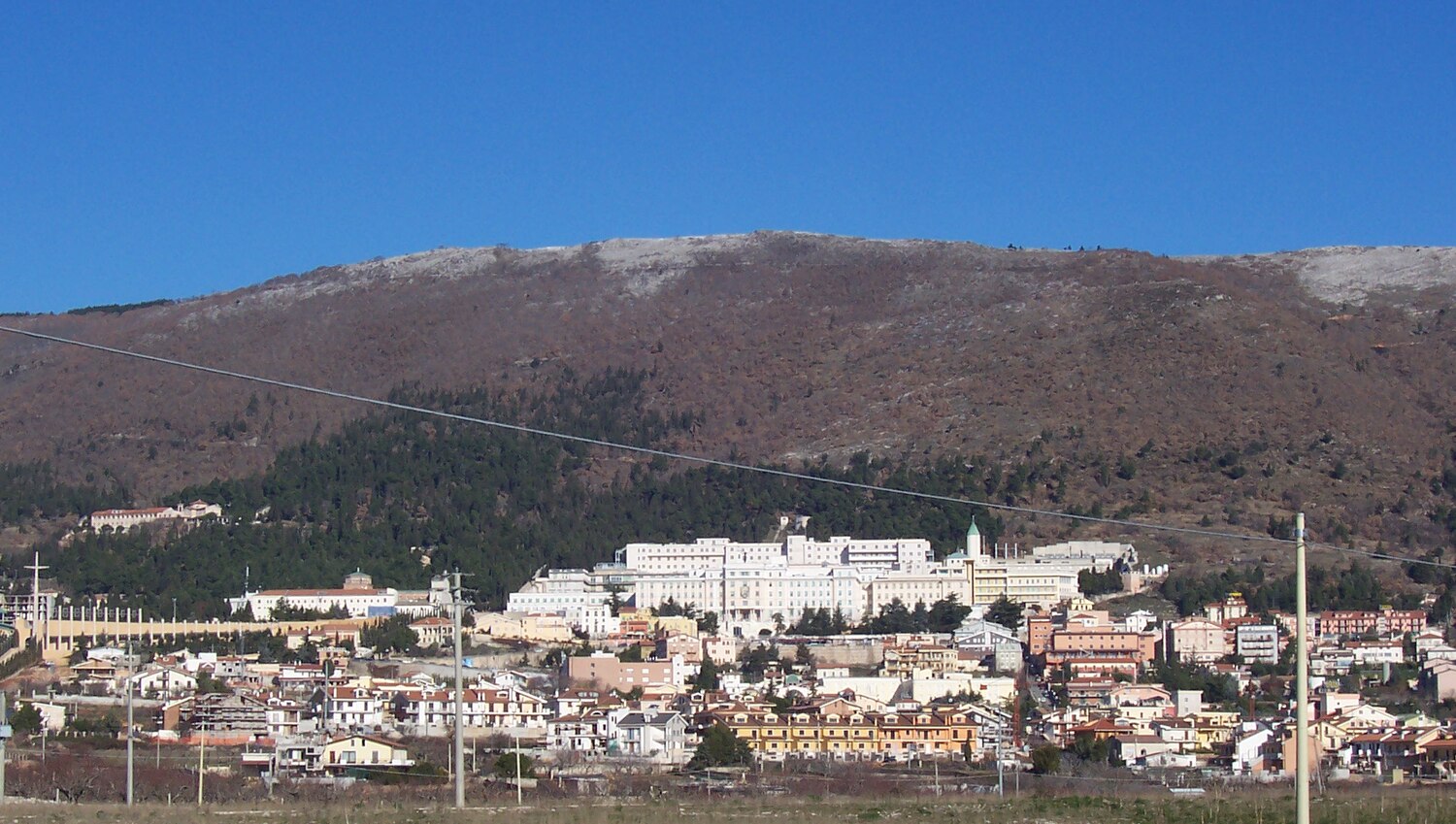
For all the mysticism, Padre Pio’s most concrete legacy is a building you can be treated in today. He had long dreamed of a place where medicine and prayer would work side by side — where, as he put it, the sick would be relieved in body and soul. In 1956, with funds gathered from his vast following around the world, he opened the Casa Sollievo della Sofferenza, the “House for the Relief of Suffering,” a full modern hospital set on the mountainside above the friary. He celebrated Mass on its steps at the inauguration. It was a startling thing for a poor friar to build, and it is no relic: it grew into one of the leading research hospitals in southern Italy, still treating hundreds of thousands of patients a year. There is something clarifying in it. The man of the bleeding wounds and the perfumed visions was also, flatly, a builder of a hospital — a reminder that in the Italian tradition holiness and hard practical charity were never meant to be separate things.
Death, and the wounds that closed
Padre Pio died on 23 September 1968, at San Giovanni Rotondo, aged eighty-one, his health finally giving way. A curious detail, reported by several who were near him and still debated by others, belongs to the honest account: in his last weeks the wounds he had carried for fifty years are said to have begun to close, so that by the end the skin of his hands, scarred for half a lifetime, was found smooth and unmarked. His devotees read it as a kind of signing-off; sceptics note that the sources do not all agree. Either way, his funeral drew a crowd that stunned the country — the measure of how far the silenced friar had travelled in the public mind while Rome deliberated.
From suspicion to the altars
The rehabilitation, when it came, was complete. Padre Pio was beatified on 2 May 1999 and canonised on 16 June 2002 by Pope John Paul II, before one of the largest crowds ever gathered in St Peter’s Square. There is a thread worth pulling here, too: the pope who made him a saint had, as a young Polish priest decades earlier, travelled to San Giovanni Rotondo to meet him. The friar his Church had once silenced was raised to its altars by a pontiff who had knelt in front of him. His feast is kept on 23 September, the day he died, and his popular devotion in Italy is almost without rival — by some surveys more Italians pray to Padre Pio than to any other saint.
Is his body incorrupt?
This is a question many pilgrims arrive with, and — as with the millennial saint Carlo Acutis, buried not far across the country — the honest answer is more careful than the legend. When his body was exhumed in 2008, forty years after his death, Church officials described it as being in “fair condition,” not as miraculously incorrupt. The face, in particular, had decayed, and so before the body was placed on public display it was given a lifelike silicone mask, moulded to his features, so that pilgrims would see the familiar bearded face rather than the reality of four decades in the tomb. What rests today in a crystal tomb in the shrine at San Giovanni Rotondo is therefore a conserved and reconstructed body, reverently presented — not a corpse untouched by time. We say so plainly, not to diminish the devotion, but because telling the difference between the veneration and the claim is exactly the sort of clear sight a pilgrim should travel with.
The thread, unbroken
Why does Padre Pio belong on a site about journeys to Christian Italy? Because he answers, in living memory, a question the modern traveller cannot help asking: did any of this go on happening? On this site we usually stand far back in time — on the road St Paul walked into Rome, in the cell where he was held, above the tomb beneath St Peter’s. Padre Pio stands at the near end of the same line. A friar with the wounds of the crucifixion, examined by twentieth-century doctors, building a hospital, silenced and then canonised, dead within the lifetime of people now in their sixties: whatever you believe about him, he is proof that the oldest claims of the faith were still being made, and still being fought over, inside the modern world. Prepare your heart, not just your suitcase, and San Giovanni Rotondo stops being a curiosity on a map of southern Italy and becomes what it is for the seven million — the place where the thread pulls tight enough to feel.
Visiting San Giovanni Rotondo and the holy mountain
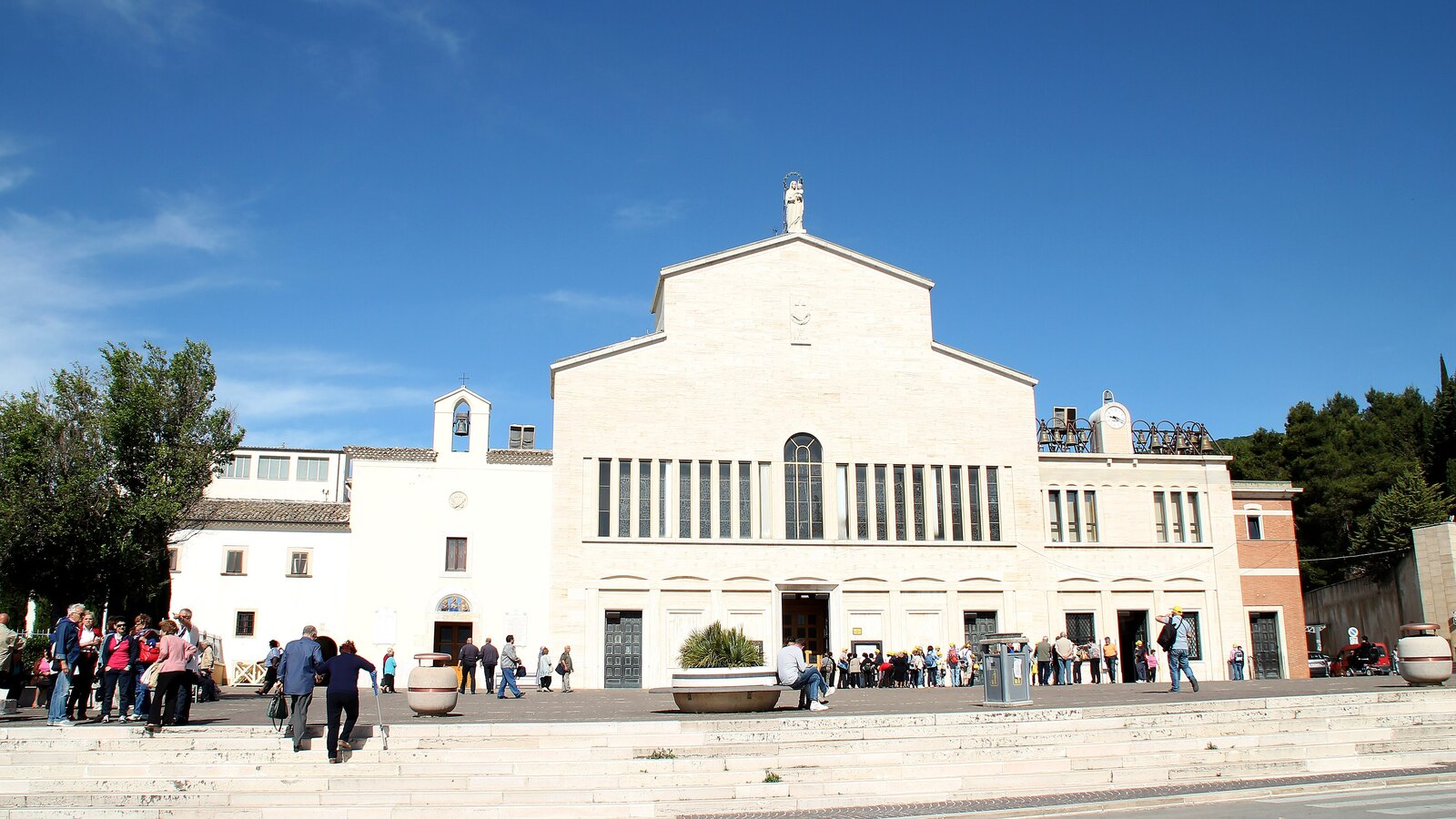
The shrine sits high on the Gargano, in the province of Foggia, in northern Puglia — the spur on the back of Italy’s heel. There are really three places to see, a short walk apart: the old friary church of Santa Maria delle Grazie, where Padre Pio lived, bore the stigmata and heard confessions; the vast modern pilgrimage church built in 2004 by the architect Renzo Piano to hold the crowds; and, between them, his tomb. Above it all stands the hospital he founded, still at work. Come outside the great feast days if you can take it slowly; the place rewards quiet.
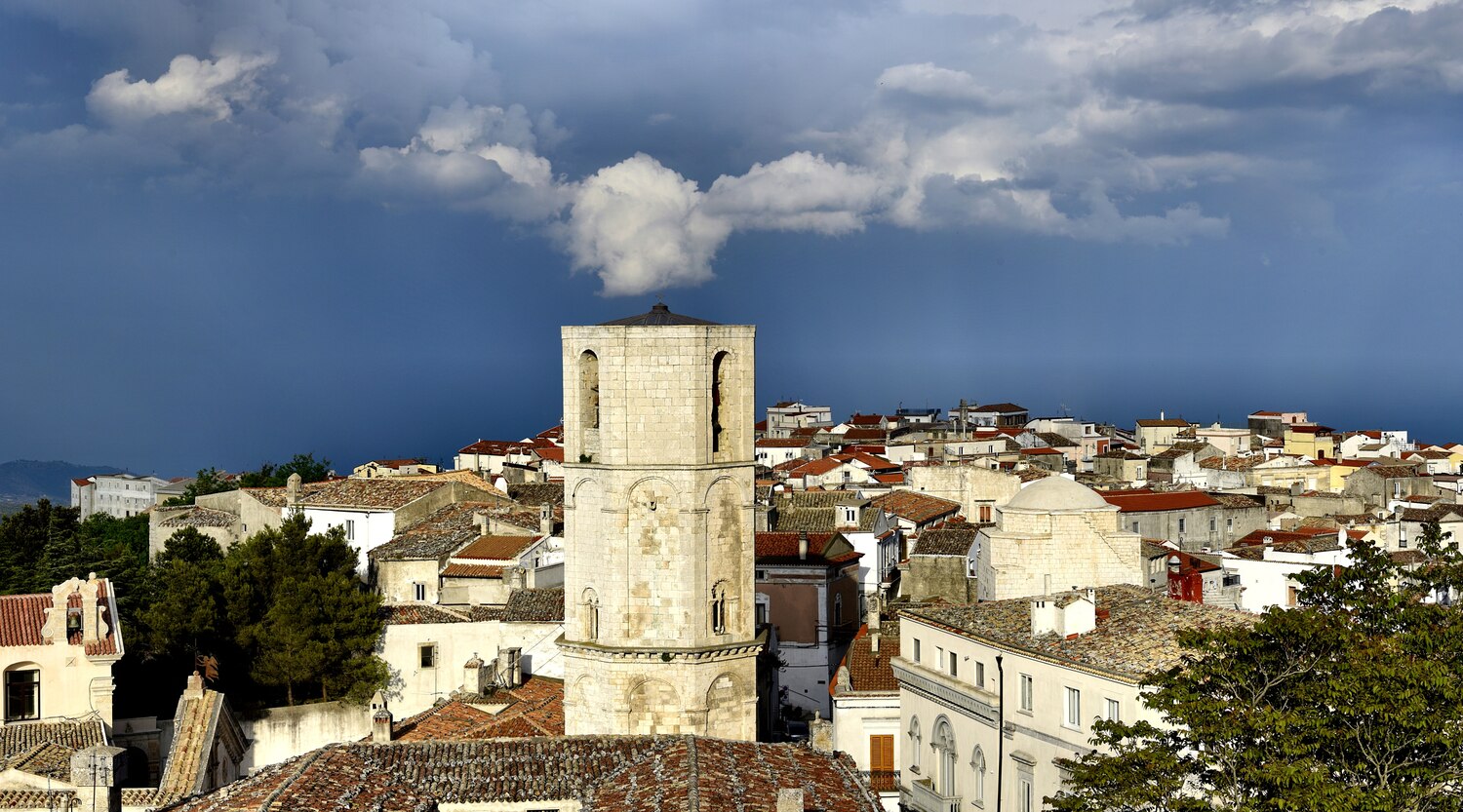
And do not stop at the town. The Gargano has been a holy mountain far longer than Padre Pio — for fifteen centuries. A short drive away, at Monte Sant’Angelo, is the cave-sanctuary of St Michael the Archangel, where, by tradition, the Archangel appeared in the late fifth century; it became one of the great pilgrimage goals of the Middle Ages, a fixed point on the roads that carried the devout across Europe and, for some, onward to Jerusalem. To stand on the Gargano is to stand where pilgrims have come for a very long time, and still come — the ancient and the modern devotion sharing one windswept ridge. It is the kind of connection we build our journeys to reveal: not a saint in isolation, but a place thick with the continuous life of the faith.
Whether you are a pastor planning a trip for your congregation or a family travelling on your own, we build journeys through Christian Italy around understanding — so that a place like the Gargano becomes a living chapter of the faith, not just a name on an itinerary. Tell us about your trip and we’ll start planning it with you.
Plan your pilgrimage →Common questions
An Italian Capuchin friar (1887–1968) who for fifty years bore the stigmata — the wounds of Christ’s crucifixion. Based at San Giovanni Rotondo in Puglia, he was famous for marathon confessions and reported miracles, and was canonised by Pope John Paul II in 2002.
The stigmata are wounds matching those of the crucified Christ — in the hands, feet and side. Padre Pio received visible, permanent stigmata on 20 September 1918, while praying in his friary church, and carried them for about fifty years — the first priest known to bear them.
His rapid fame and claimed miracles made Rome cautious. In the 1920s and 1930s the Holy Office investigated him and, at times, forbade him to say Mass publicly or hear confessions. The suspicion eased only slowly; he was fully vindicated with his canonisation in 2002.
No. When his body was exhumed in 2008 it was described as being in “fair condition,” not incorrupt; the decayed face was covered with a lifelike silicone mask before public display. What pilgrims see in his tomb is a conserved and reconstructed body, not one untouched by time.
At San Giovanni Rotondo, on the Gargano in Puglia, where his tomb lies in the shrine beside the friary of Santa Maria delle Grazie and the large church built by Renzo Piano. It is one of the world’s most visited Catholic pilgrimage sites, open to all, drawing some seven million people a year.
The “House for the Relief of Suffering,” the hospital Padre Pio founded at San Giovanni Rotondo, opened in 1956. He meant it to join medicine and prayer; it is now one of the leading research hospitals in southern Italy and still treats hundreds of thousands of patients a year.