The Twelve Apostles: Who They Were, and Where They Rest in Italy
They were, by any ordinary measure, an unlikely group: a handful of fishermen from a provincial lake, a despised tax collector, a political firebrand, a few men whose names we barely know. Jesus chose twelve of them to be his closest companions, and after his death and resurrection these same frightened, uncertain men walked out of a locked room in Jerusalem and set about changing the world — carrying a message about a crucified Galilean to the ends of the Roman Empire and beyond, and dying, almost to a man, for refusing to stop. We call them the Twelve Apostles, from the Greek word for “those who are sent,” and the Church they founded still rests, as Scripture says, “on the foundation of the apostles.” What far fewer people know is how many of them, at the end of their scattered journeys, came to rest in the soil of Italy — so that the traveller who wishes to can stand today at the tombs of the men who knew Jesus face to face.
Who were the Twelve?
The Gospels tell us that Jesus called his disciples one by one, often from the most everyday of lives — “Follow me,” he said to the fishermen Peter and Andrew as they cast their nets, “and I will make you fishers of men” — and from a wider circle of followers he chose twelve to be his inner company. Their names, gathered from the Gospel lists, are these: Simon Peter and his brother Andrew; James and John, the sons of Zebedee, whom Jesus nicknamed the “sons of thunder”; Philip; Bartholomew, often identified with Nathanael; Thomas, remembered forever as the doubter who needed to touch the wounds; Matthew, the tax collector called from his booth; James the son of Alphaeus, known as James the Less; Jude Thaddaeus; Simon the Zealot, once a member of a fierce nationalist party; and Judas Iscariot, who would betray him. They were not scholars or priests or men of rank, and that was rather the point: the faith that would conquer the empire of Rome was entrusted first to ordinary working men. They were, if anything, a scandalously mixed company: Matthew had been a tax collector, a profession his countrymen despised as collaboration with the Roman occupier, while Simon had belonged to the Zealots, the fierce party that dreamed of driving Rome out by the sword — two men who in ordinary life would have been enemies, now seated at the same table. That Jesus bound such different, flawed and unremarkable people into one company is part of the point the Gospels press: the Church was never meant to be a club of the perfect. Among them an inner three — Peter, James and John — were closest of all, present at the moments the others were not, and it is Peter, impulsive and warm-hearted, whom Jesus named the rock on which he would build his Church.
The Last Supper
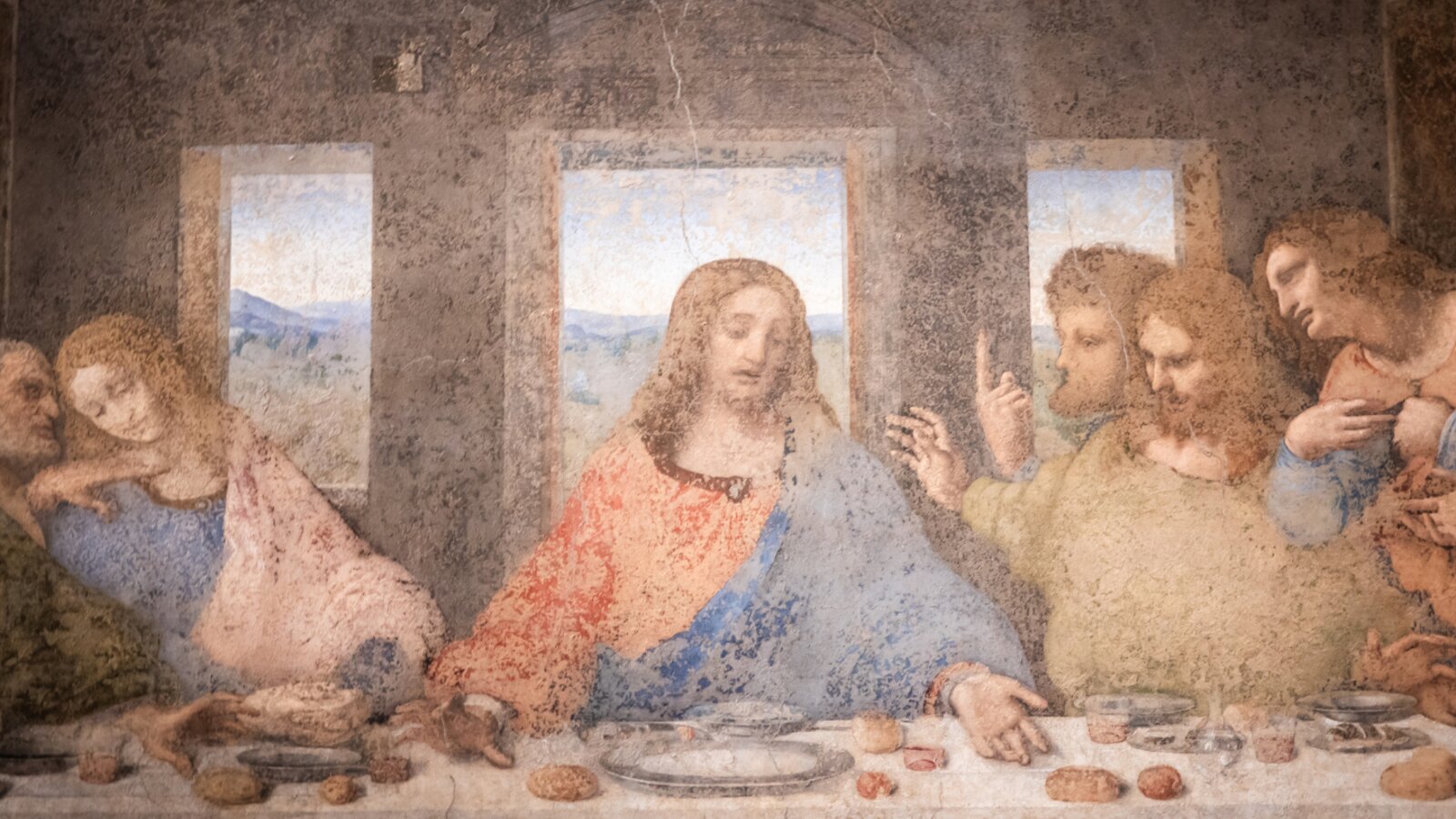
The most famous image of the Twelve, and the one at the head of this page, captures the night it all turned: the Last Supper, the Passover meal Jesus shared with his apostles in an upper room in Jerusalem on the eve of his death. It was there, Christians believe, that he took bread and wine and gave them a meaning the Church has repeated at every Mass since — “this is my body… this is my blood” — entrusting the Eucharist to the hands of the Twelve who would carry it to the world. It was there that he knelt and washed their feet, teaching that the greatest must be the servant of all; and there that he spoke the words that fell among them like a stone: “one of you will betray me.” It is exactly that moment — the instant the betrayal is named and the Twelve recoil in shock, grief and protest — that Leonardo da Vinci froze forever on the refectory wall of Santa Maria delle Grazie in Milan, in the painting the world simply calls The Last Supper. Fragile, fading and endlessly studied, it remains the supreme portrait of the apostles as living men, every face a different answer to an unbearable truth — and it is, fittingly, one of the treasures of Italy, the country where so much of their story would finally come to rest.
Judas, and the twelfth place
The number twelve was not an accident. It deliberately echoed the twelve tribes of ancient Israel, a sign that in these men a new people of God was being founded; and so, when the circle was broken, it had to be restored. Judas Iscariot, after handing Jesus over to his enemies for thirty pieces of silver, despaired and took his own life, leaving the Twelve as eleven. In the days after the Resurrection, as recorded in the Acts of the Apostles, the remaining apostles cast lots to choose a replacement from among the wider body of disciples who had been with Jesus from the beginning, and the lot fell on a man named Matthias, who took the empty place so that the Twelve were twelve once more. It is a small, telling episode: the first thing the infant Church did, even before it received the Spirit at Pentecost, was to make itself whole again, insisting that the foundation Jesus had laid should stand complete.
“Follow me, and I will make you fishers of men.”The Gospel of Matthew 4
To the ends of the earth
At Pentecost, the Acts of the Apostles tells us, the Holy Spirit descended on the Twelve in wind and fire, and the men who had scattered and hidden behind locked doors on the night of the arrest were transformed, overnight, into fearless preachers who would face down the same authorities that had crucified their master. It is one of the strangest and most consequential turnarounds in history: a broken, terrified band became, within weeks, the founders of a movement that would outlast Rome itself. From Jerusalem they scattered across the known world, and though the Gospels follow only a few of them, the ancient traditions of the Church trace their astonishing journeys. Thomas, the doubter, is said to have carried the faith farthest of all, east through Persia and all the way to India, where the Saint Thomas Christians still trace their origin to him. Andrew preached around the Black Sea and in Greece, where he was crucified at Patras on an X-shaped cross that bears his name. James the Greater, the son of Zebedee, was the first of the Twelve to be martyred, beheaded in Jerusalem, and tradition carried his body to Spain, to Santiago de Compostela, which became one of the greatest pilgrim destinations in Christendom. John, alone of the Twelve, is said to have died of old age, at Ephesus — but not before a long exile on the rocky island of Patmos, where tradition holds that he received the visions written down as the Book of Revelation, the final book of the Bible. The rest went out across the ancient world and, the great majority of them, to violent deaths for their preaching. Bartholomew is said to have been flayed alive in Armenia, which is why painters show him holding his own skin; Philip died at Hierapolis in Asia Minor; Simon and Jude Thaddaeus are remembered as martyrs together in Persia; Matthew was killed, by some accounts in Ethiopia, by others in Persia; and Matthias, the apostle chosen to replace Judas, met his own martyr’s end. Crucified, beheaded, flayed, stoned and speared, they died scattered across three continents. These men were not writing a comfortable religion. They were sealing it with their lives, and the map of their deaths is the map of how a faith from one small province reached the whole of the ancient world.
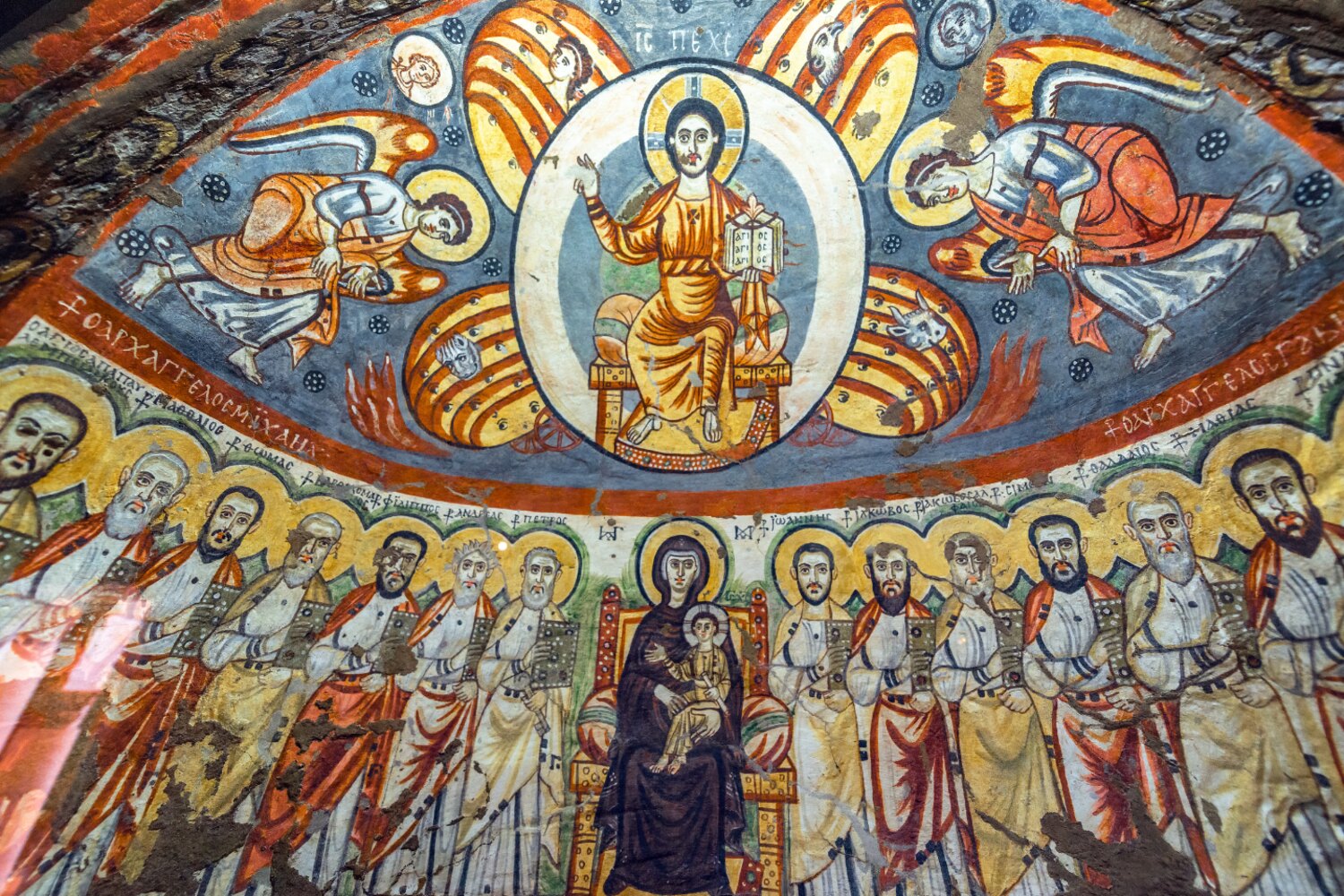
Peter and Paul, the two pillars of Rome
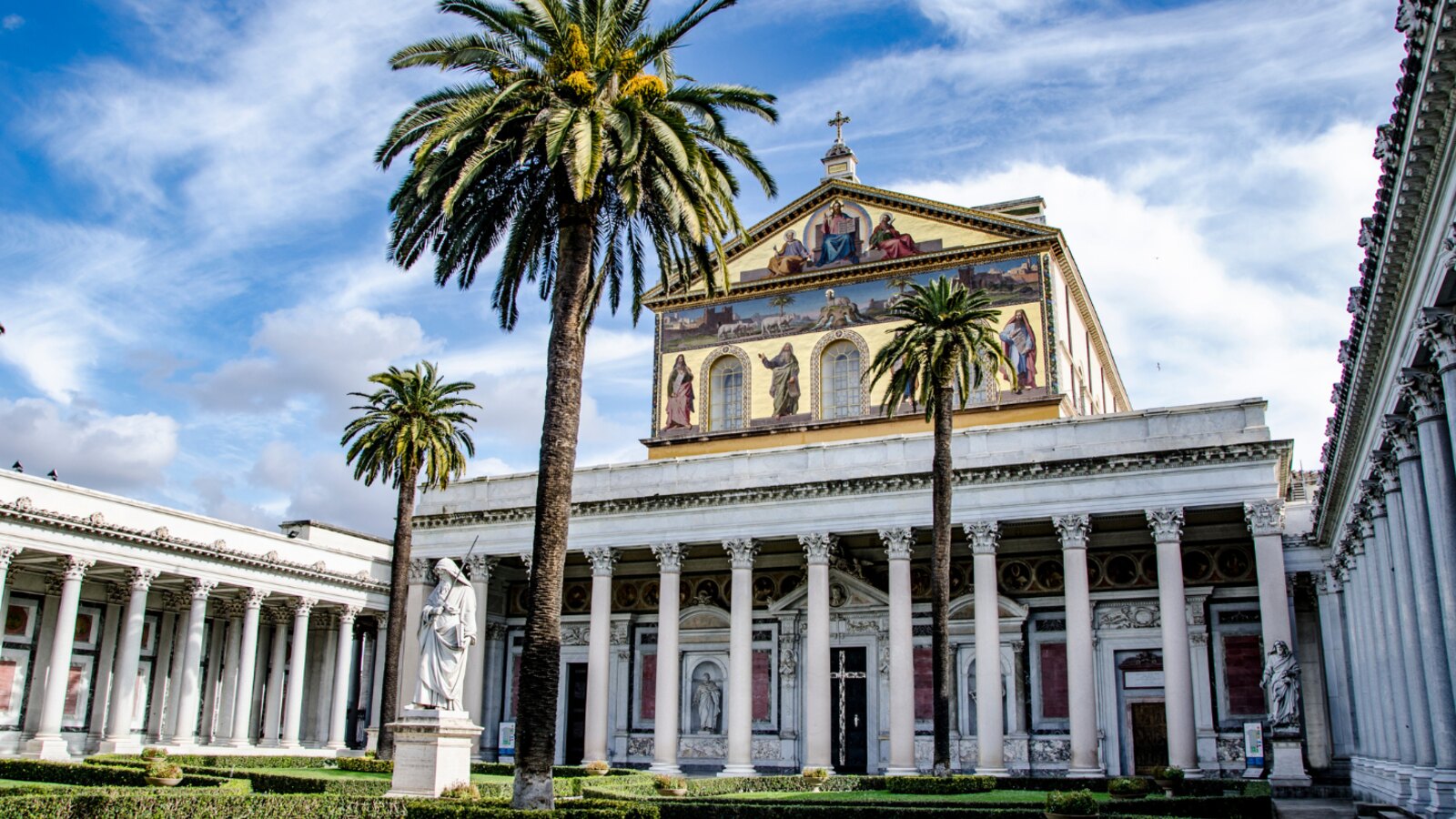
Two of the apostles’ journeys ended in the capital of the empire itself, and they made Rome what it has been ever since. Peter is the one we know best, and the most human of them all: the impulsive fisherman who walked on the water and then sank for lack of faith, who swore he would never abandon his master and then, on the night of the arrest, denied three times that he even knew him — and who wept bitterly when he heard the cock crow. Yet it was precisely this fallible man whom the risen Christ forgave and restored by the lakeside, telling him three times, once for each denial, “Feed my sheep,” and to whom he had given the keys and the name Peter, the rock. He became the leader of the apostles and, in the Church’s understanding, the first bishop of Rome — the first in the long line of popes. Peter came at last to Rome and was crucified there under the emperor Nero — head downward, tradition says, because he felt unworthy to die as his Lord had — and was buried on the Vatican hill, where the basilica that bears his name now rises over his grave. With him is always named Saint Paul, who, though not one of the original Twelve, is honoured equally as an apostle, and who was beheaded on the road to Ostia and buried where the Basilica of St Paul Outside the Walls now stands. Rome keeps the feast of the two together on the twenty-ninth of June, and calls them the pillars of the Church, for it was their blood, more than any decree, that transformed the city of the Caesars into the centre of the Christian faith. To understand why Rome matters so immensely to Christianity, you have to begin with the simple fact that two of the men who walked with Jesus, or were called by him, are buried in its ground.
The apostles who rest in Italy
Here is what surprises almost everyone, and what makes Italy such extraordinary ground for a journey of faith: a remarkable number of the Twelve are venerated not in the distant East but on Italian soil, their relics carried here over the centuries and enshrined in cathedrals you can still visit. In the Middle Ages the bones of an apostle were among the most precious things a city could own, drawing pilgrims, prestige and heavenly protection, and the Italian ports in particular — Venice, Amalfi and the towns of the Adriatic — competed to bring them home from the crumbling Christian East, which is much of how the Twelve came to lie beneath Italian altars. Saint Matthew, the evangelist, lies in the crypt of the cathedral of Salerno, south of Naples, where his relics have been honoured since the tenth century. Saint Thomas — the apostle of India — rests, astonishingly, in the Adriatic town of Ortona, in Abruzzo, his bones brought from the Greek island of Chios in 1258 and kept there in a golden casket to this day. Saint Andrew, Peter’s brother, lies in the cathedral of Amalfi, brought from Constantinople in 1208. In Rome itself, the Basilica of the Holy Apostles — Santi Apostoli — holds beneath its altar the shared tomb of Saint Philip and Saint James the Less; the relics of Saint Bartholomew are venerated on the little island in the Tiber in the church that bears his name (though the town of Benevento disputes the claim); and the great Basilica of St Peter’s guards, besides Peter himself, the relics of Saint Simon and Saint Jude Thaddaeus, past whose altar millions of pilgrims walk without ever knowing it; and a portion of the relics of Saint Matthias, the apostle chosen to fill Judas’s place, is honoured in the great basilica of Santa Maria Maggiore. To travel Italy with this knowledge is to realise that the men of the Gospel are not only figures in a distant book but a presence beneath the altars of its churches.
Why the Twelve still matter
The apostles are not simply a list of saints to be admired; they are, in the oldest Christian understanding, the very foundation on which everything that follows is built. It was to them that Jesus entrusted his teaching, to them that he gave the command to “go and make disciples of all nations,” and from them — by the unbroken laying-on of hands the Church calls apostolic succession — that bishops and priests trace their authority to this day. Every creed professes belief in a Church that is “apostolic”; every reading of the Gospels rests on the memory these men preserved and passed on. They were eyewitnesses, the last human link to Jesus himself, and they spent their lives insisting, under torture and before executioners, that what they had seen was true. One may believe them or not, but their conviction is a historical fact of the first importance: a dozen ordinary men who had every reason to go quietly home chose instead, almost without exception, to die rather than deny what they claimed to have witnessed. The whole vast edifice of Christianity rests, in the end, on the testimony of the Twelve. There is an old argument, often put too crudely but worth stating with care: men do not willingly die for what they know to be a lie. Whatever one finally concludes about the Resurrection itself, the apostles plainly believed, with a conviction that outlasted imprisonment and torture, that they had seen the risen Christ with their own eyes — and that belief, held to the point of death by men who had everything to lose, is the spark from which all the rest caught fire.
Walking with the apostles in Italy
For a pilgrim, all of this turns the map of Italy into something remarkable: a land where the apostles can be visited one by one. It begins, of course, in Rome, the city of Peter and Paul, where St Peter’s Basilica rises over the first pope’s tomb, St Paul Outside the Walls over the apostle of the Gentiles, and the quieter churches of the Holy Apostles, of St Bartholomew on the Tiber island, and of so many martyrs hold their own relics. From Rome the trail of the Twelve leads outward across the country: south to Salerno for Saint Matthew and along the coast to Amalfi for Saint Andrew; east across the mountains to Ortona on the Adriatic for Saint Thomas, who carried the Gospel as far as India and came home, at the last, to a small Italian town. Few countries on earth let you stand in the presence of so many of the men who knew Jesus. To make that journey with understanding — to know whose bones lie beneath the gold and marble, and what those men did and suffered — is to turn a tour of beautiful churches into something far deeper: a meeting, across twenty centuries, with the witnesses on whom the whole of the faith still stands.
Whether you are a pastor planning a journey for your congregation or a traveller going on your own, we build trips through Christian Italy around understanding — so that the tombs of the apostles, from Rome to Salerno to Ortona, become a meeting with the witnesses of the Gospel rather than a list of churches. Tell us about your trip and we’ll start planning it with you.
Plan your pilgrimage →Common questions
They were the twelve closest followers chosen by Jesus: Peter, Andrew, James and John (sons of Zebedee), Philip, Bartholomew, Thomas, Matthew, James the Less, Jude Thaddaeus, Simon the Zealot, and Judas Iscariot. After Judas’s betrayal, Matthias was chosen to replace him, restoring the number to twelve.
The number twelve deliberately echoed the twelve tribes of Israel, signifying that in the apostles a renewed people of God was being founded. When Judas was lost, the early Church was careful to choose Matthias in his place so that the symbolic number of twelve would remain complete.
Tradition holds that almost all of the Twelve were martyred for their preaching: Peter crucified in Rome, Andrew at Patras, James the Greater beheaded in Jerusalem, Thomas speared in India, and others killed across the ancient world. John is traditionally the only apostle said to have died of natural causes, at Ephesus.
A remarkable number. Peter and Paul in Rome; Matthew at Salerno; Thomas at Ortona in Abruzzo; Andrew at Amalfi; Philip and James the Less in the Basilica of the Holy Apostles in Rome; Bartholomew on the Tiber island; and Simon and Jude in St Peter’s. Italy holds the tombs of more apostles than any other country.
No. Paul was not one of the original Twelve — he never knew Jesus during his earthly life — but he is honoured as an apostle because of his vision of the risen Christ and his immense missionary work. Rome celebrates Saints Peter and Paul together as the two pillars of the Church.
The word comes from the Greek apostolos, meaning “one who is sent.” It describes the Twelve as those sent out by Jesus to preach the Gospel and found the Church, which the creeds still call “apostolic” because its faith and ministry are traced back to them.