The Eucharistic Miracles of Italy: Lanciano, Orvieto, Siena
Scattered across Italy are a handful of objects that the Church keeps under glass and that stop even sceptical visitors in their tracks: a piece of what is said to be human flesh and five pellets of dried blood, venerated for some thirteen centuries at Lanciano; a linen altar-cloth stained, by tradition, with blood that once flowed from a consecrated host, enshrined in the painted splendour of Orvieto cathedral; and a ciborium of communion wafers in Siena that have simply refused to decay for nearly three hundred years. These are the Eucharistic miracles of Italy — the most famous of a strange category of events in which, Catholics believe, the bread and wine of the Mass became visibly what their faith holds them to be. They are fascinating, they have been poked at by scientists, and — this matters — the Church does not oblige anyone to believe a single one of them.
We write about them in that spirit: not to sell a wonder and not to sneer at one, but to set out plainly what is claimed, what has actually been tested, and where the honest limits of the evidence lie. Of everything in Italy, this is the subject most often oversold, and it is far more interesting told straight.
What is a Eucharistic miracle?
To understand why these objects matter you have to understand the belief behind them. At the centre of Catholic faith is the doctrine of the Real Presence: the conviction that at Mass the bread and wine genuinely become the body and blood of Christ, while still looking and tasting like bread and wine. A “Eucharistic miracle” is a reported event in which that hidden change is said to have become briefly, physically visible — a host that bleeds, or turns to flesh, or remains incorrupt long after it should have crumbled to dust. Dozens of such claims are scattered through the history of the Church, most of them medieval, and a great many of them Italian; the Church investigates them case by case, approves some for local devotion and quietly sets others aside, and never makes belief in any of them a requirement of the faith. Italy holds the three most celebrated, and they are worth knowing one at a time.
Lanciano: flesh and blood, kept for thirteen centuries
In the little town of Lanciano, in Abruzzo, tradition tells of a monk of the order of St Basil celebrating Mass around the eighth century who was tormented by doubt about the Real Presence — and who watched, as he spoke the words of consecration, the host turn into living flesh and the wine into blood that separated into five irregular globules. That flesh and those five pellets of dried blood have been preserved and venerated ever since in the church of San Francesco at Lanciano, and they are still there to be seen. In 1970 the Franciscan custodians allowed the relics to be examined scientifically, and the following year Professor Odoardo Linoli, a specialist in anatomy and pathology, presented his conclusions: the flesh, he reported, was genuine human tissue from the wall of a heart, and the blood was genuine human blood of type AB, with no trace of any preservative. For believers the findings were electrifying.
Here honesty obliges a second paragraph the souvenir shops leave out. Linoli’s study was essentially the work of one man, published in a minor journal and never independently replicated under modern controls; other scientists have noted that the AB blood-group result is not as decisive as it sounds, since common bacteria can mimic the same signature on old tissue. More importantly, the dramatic claim you will see everywhere — that the World Health Organization ran a fifteen-year, five-hundred-test study and confirmed the miracle — is simply false: that document has been shown to be a fabrication, stitching the Lanciano material together with unrelated research on Egyptian mummies. None of this proves Lanciano is not what tradition says it is. But a relic venerated for thirteen centuries deserves to be defended with the truth and not with a hoax, and the honest position is that Lanciano remains a genuine mystery, not a closed scientific case.
Bolsena and Orvieto: the host that bled, and the feast it created
The second great miracle changed the calendar of the whole Western Church. In 1263, by tradition, a priest troubled by doubt about the Real Presence was saying Mass in the town of Bolsena, on its lake north of Rome, when the host he had just consecrated began to bleed, staining the corporal — the white linen cloth spread beneath it on the altar. Pope Urban IV happened to be staying a few miles away in Orvieto; the bloodstained corporal was carried to him there, and it is kept to this day in the Chapel of the Corporal inside Orvieto’s cathedral — one of the supreme achievements of Italian Gothic, a cliff of striped marble and glittering mosaic raised in no small part to house this single cloth. The following year, in 1264, Urban IV instituted the feast of Corpus Christi — Corpus Domini — which is still kept across the Catholic world, and tradition holds that he asked Thomas Aquinas, the greatest theologian of the age, to compose its hymns and prayers. Historians note that the papal decree did not actually name Bolsena, so the link is one of long tradition rather than documented cause; but the thread from a doubting priest’s altar to a universal feast, by way of a cathedral built around a cloth, is one of the most remarkable in the history of the Church.
Siena: the hosts that would not decay
The third is the quietest and, in its way, the most unsettling, because it is still, in a sense, going on. In August 1730 thieves broke into the Basilica of San Francesco in Siena and stole a ciborium full of consecrated hosts; days later the wafers were found stuffed into the offering box of another church, dirty but intact, and returned to San Francesco. There they have remained ever since — and there they still are, nearly three centuries later, whole and unspoilt, where ordinary unconsecrated wafers of flour and water would have crumbled to powder within a few years. They have been examined more than once and no natural explanation has been settled on; the Church venerates them as a standing miracle of preservation, a Eucharistic sign not of blood but of simple, stubborn incorruption. It is a strange thing to stand in front of: not a dramatic event centuries past, but a cupboard of bread that has, by every ordinary expectation, refused to die.
The Church does not command you to believe them. It simply keeps them, and lets you look.
Are they real? What can honestly be said
The honest answer is the same one we give for the Shroud of Turin: these are open questions, not settled proofs, and anyone who tells you otherwise — in either direction — is overreaching. Some of the objects have been studied and have yielded genuinely puzzling results; none has been examined with the full, repeated, independent scrutiny that would turn a devotional claim into an established scientific fact, and some of the “proof” that circulates online is exaggerated or, as at Lanciano, outright fabricated. At the same time, the relics are really there, really old, and in some cases really unexplained. The Church itself holds the sane middle ground: it permits and encourages devotion to approved miracles while never making belief in them obligatory, treating them as signs to ponder rather than doctrines to enforce. That restraint is exactly why they are worth visiting with a clear head — neither as a trap for the credulous nor as a joke for the cynical, but as real objects at the strange border of faith and evidence.
The boy who catalogued them
It is fitting that the person who did most to make these scattered Italian relics known to the modern world was himself a modern Italian, and now a saint. As a teenager in the early 2000s, Carlo Acutis — the computer-loving boy canonised in 2025 as the first millennial saint — built a website and a travelling exhibition documenting more than a hundred Church-recognised Eucharistic miracles from around the world, Lanciano and Bolsena and Siena among them. A teenager’s laptop, bent to the service of the oldest devotion in the Church: it is the same unbroken thread we follow everywhere on this site, reaching from an eighth-century altar in Abruzzo to a boy in trainers who died in 2006 and now lies in Assisi.
Why they belong on a pilgrimage to Italy
These relics are the clearest proof of why we prepare travellers to understand before they look. Walk into the cathedral of Orvieto knowing nothing, and you see a dazzling building and a framed old cloth; walk in understanding the doubting priest, the blood on the linen, the pope in the town, the feast it gave the world and the honest argument over all of it, and you are standing inside one of the great stories of medieval Christendom. The point of a pilgrimage, as we always say, is not to tick off a relic but to arrive with the context that makes it mean something — to recognise the world a sign came from and the thread that runs, unbroken, from it to you. The Eucharistic miracles reward that preparation more than almost anything in Italy, precisely because they sit on the knife-edge between faith and evidence where a prepared mind is worth everything.
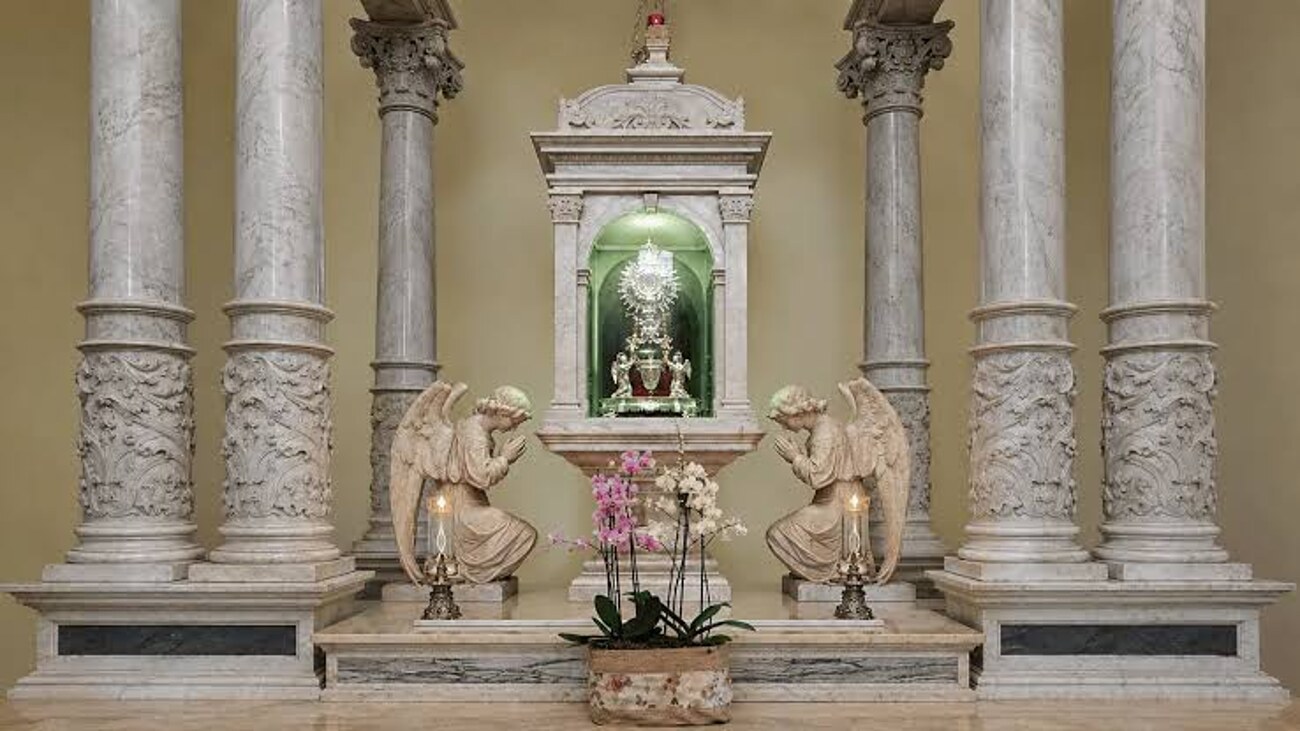
Seeing them: Lanciano, Orvieto and Siena
The three sites lie in a broad arc down the centre of Italy, and each rewards the visit in its own way. Lanciano, in Abruzzo east of Rome, keeps its flesh-and-blood relic in the church of San Francesco in the old town, a quiet place far off the usual tourist routes. Orvieto, dramatically set on its tufa cliff in southern Umbria and an easy stop on the Rome–Florence line, holds the corporal in a cathedral whose facade alone justifies the journey — and the town, with its underground caves and its white wine, repays a full day. Siena, the great Gothic city of Tuscany, keeps its incorrupt hosts in the Basilica of San Francesco, a short walk from the shell-shaped Campo and from the relics of St Catherine. Seen together, with their stories understood, the three turn a line on a map into a single meditation on the heart of the Catholic Mass — which is exactly the kind of connected, prepared journey we are built to design.
Whether you are a pastor planning a trip for your congregation or a traveller going on your own, we build journeys through Christian Italy around understanding — so that a relic like Lanciano or Orvieto becomes a story you can stand inside, honestly told, rather than a glass case you hurry past. Tell us about your trip and we’ll start planning it with you.
Plan your pilgrimage →Common questions
A reported event in which the consecrated bread or wine of the Mass is said to have become visibly flesh or blood, or to have stayed incorrupt far longer than natural. Catholics see it as the hidden Real Presence of Christ made briefly physical. The Church approves some cases for devotion but never requires belief in them.
Three above all: Lanciano, in Abruzzo, where a host is said to have become flesh and blood around the eighth century; Bolsena-Orvieto (1263), where a host bled onto an altar cloth now kept in Orvieto cathedral; and Siena (1730), where consecrated hosts have remained intact for nearly three centuries.
Not conclusively. A 1970–71 study reported that the Lanciano relic is human heart tissue and type AB blood, but it was essentially one researcher’s work and has not been independently replicated. The widely repeated claim of a confirming WHO study is a documented fabrication. It remains a genuine but unproven mystery.
By tradition, a doubting priest’s host bled at Bolsena in 1263 while Pope Urban IV was nearby in Orvieto. The next year, in 1264, Urban IV instituted the feast of Corpus Christi for the whole Church. The decree did not name Bolsena, so the link is one of long tradition rather than documented cause.
No. Like other private miracles and apparitions, they are never articles of faith. The Church may approve a case for local devotion after investigation, but it leaves the faithful free to believe or not, treating such events as signs to ponder rather than doctrines to be held.
Lanciano’s relic is in the church of San Francesco in Lanciano, Abruzzo; the Bolsena corporal is in the Chapel of the Corporal in Orvieto Cathedral, Umbria; and the incorrupt hosts of 1730 are in the Basilica of San Francesco in Siena, Tuscany. All three are open to visitors.