St Catherine of Siena: the Woman Who Told the Pope to Go Home
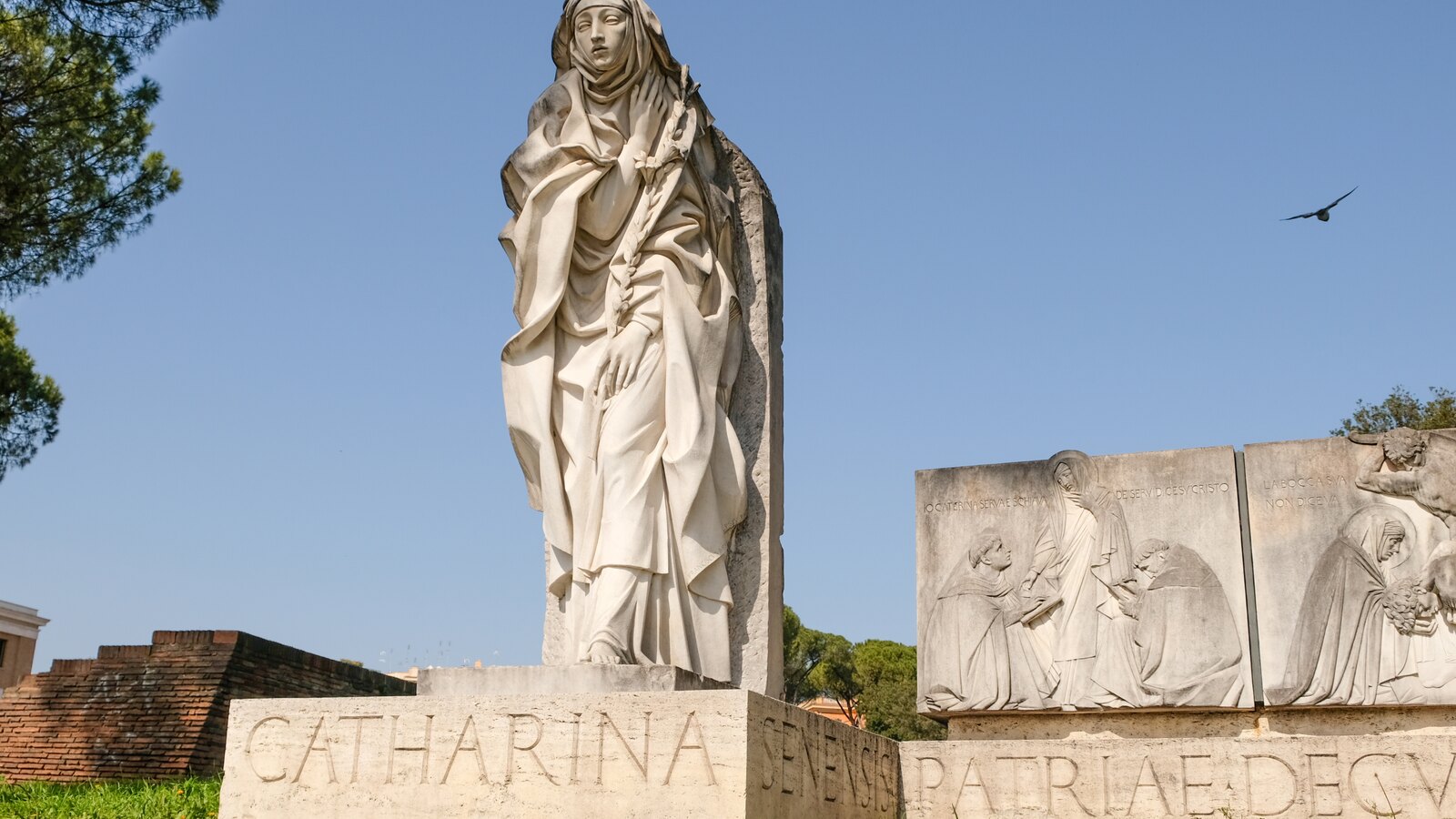
She was a dyer’s daughter from Siena who could barely write, died at thirty-three, and in her short life wrote letters that bullied and begged the most powerful man in Christendom — the Pope — to leave France and come home to Rome. He came. Six hundred years later she is a Doctor of the Church, a patron saint of Italy and co-patron of Europe, and her body lies in Rome while her head is kept, dark and shrunken behind glass, in her home city. Catherine of Siena is one of the most astonishing figures the Middle Ages produced, and almost nothing about her fits the meek image the word “saint” usually calls up.
For a traveller to Tuscany she is also the key that unlocks Siena — not just the beautiful shell-shaped square and the striped cathedral, but the city as a place where a single extraordinary life still shapes what you see. As on every journey we plan, the point is to arrive understanding who walked these streets, so that Siena becomes a story rather than a backdrop: pilgrimage, not tourism.
A dyer’s daughter in plague-time Siena
Caterina Benincasa was born in Siena in 1347 — the very year the Black Death reached Europe — one of the youngest of a very large family; her father was a cloth-dyer. Siena then was a rich, proud, violent city-republic, Florence’s great rival, and within her childhood the plague would cut its population roughly in half. Catherine grew up in that shadow and set her face against the ordinary path laid out for a girl of her class: she refused marriage, cut off her hair to put off suitors, and in her teens joined the Mantellate, the Dominican women who wore the order’s habit but lived in their own homes and served the poor and the sick rather than retreating behind convent walls. She nursed plague victims in Siena’s hospital with a fearlessness that unnerved those around her, tending cases others would not go near, and she began to be known, first in the city and then far beyond it, as a woman who saw visions and spoke with an authority no one could quite account for in someone so young, so female, and so unlettered.
From childhood Catherine had described intense mystical experiences: a first vision of Christ at the age of six, and later what she called a “mystical marriage” to him, sealed in private. By tradition she received the stigmata — the wounds of the crucifixion — in 1375 at Pisa, though she asked that they remain invisible to everyone but herself, so that, unlike the visible wounds of Padre Pio centuries later, hers were known only on her word. She also fasted to extremes that alarmed her own confessors and would trouble any modern doctor, until in the end she could take almost no food at all. It would be easy, and dishonest, to tidy this away into simple holiness. Catherine was a genuine mystic and also a woman whose austerities were severe even by the standards of a severe age, and both of those things are part of the truth of her.
The letters, and a masterpiece of Italian
Here is what lifts her clear out of the ordinary run of medieval holy women. Catherine, who had little formal schooling and for most of her life dictated rather than wrote, produced one of the monuments of early Italian literature. Nearly four hundred of her Letters survive — fired off to popes and queens, mercenary captains and condemned prisoners, nuns and whole city governments — blunt, burning, intimate and politically fearless, and shot through with a startling tenderness: she would address the Pope himself as babbo, “daddy,” in the very breath that she ordered him to find his courage. She also dictated a book of mystical theology, the Dialogue of Divine Providence. Written in the Tuscan vernacular at the precise moment it was becoming the Italian language, her prose stands not far from Dante’s and Petrarch’s in the story of how Italians learned to write their own tongue. A woman whom the Church of her day would never have allowed to preach from a pulpit instead preached, in effect, to the whole of Christendom by post — and did it in the language of ordinary people rather than the Latin of the learned.
The woman who moved the papacy
Catherine lived in the age of the “Avignon papacy,” the roughly seventy years when the popes, under heavy French influence, had abandoned Rome and ruled from Avignon in the south of France — a period Italians bitterly called a captivity, and a scandal to anyone who believed the See of Peter belonged in the city of Peter. Catherine threw the whole of her fierce energy into bringing the pope home. In 1376 she travelled all the way to Avignon to press Pope Gregory XI in person, and bombarded him with letters of extraordinary nerve, telling the Vicar of Christ, in substance, to stop being afraid and go back to Rome. In January 1377 the papacy did return, and tradition has long credited Catherine with the decision.
Honesty asks for a caveat here, and it is an interesting one. Historians debate how decisive she really was: Gregory had other reasons and other voices urging him on, among them another formidable woman, Bridget of Sweden, and the move may already have been in motion before Catherine ever reached Avignon. What is not in doubt is that a young woman with no office, no wealth and no army inserted herself into the highest politics of the Church and was taken seriously by a pope. And when the papacy split soon afterwards, in the Great Schism of 1378, with rival popes installed in Rome and Avignon at once, Catherine spent the last of her strength in Rome, writing and pleading in defence of the Roman claimant and labouring to hold a fracturing Church together. The effort consumed what little of her the fasting had left.
Death at thirty-three, and a saint in two cities
Worn out by fasting, travel and the strain of the Schism, Catherine died in Rome on 29 April 1380, at the age of thirty-three — the age, her devotees never fail to note, of Christ at the crucifixion. She was buried in Rome, in the Dominican church of Santa Maria sopra Minerva, the one great Gothic church in the city, a few steps from the Pantheon, where her body still rests beneath the high altar. But her story, and her bones, refused to stay in a single place.
Siena wanted its daughter back, and Rome, which now had a saint of its own, would not surrender the body. So — according to the traditional and much-loved account, which the honest guide will flag as legend rather than documented fact — Catherine’s Sienese followers took what they could: they removed her head and carried it out of Rome, and when the guards stopped them and opened the bag, it is said to have appeared full not of a relic but of rose petals. True or not, the division is real, and you can still see it. To this day her body lies in Rome and her head — blackened, unmistakably human, behind glass in a gilded reliquary — is venerated in the Basilica of San Domenico in Siena, along with her thumb; other relics are claimed as far away as Venice. The medieval habit of dividing a holy body among the places that loved it can unsettle a modern visitor, standing before a human head in a case; it is also, in its way, a plain measure of how fiercely this one woman was wanted.
From Siena’s daughter to Doctor of the Church
The honours gathered slowly and then grandly, long after she could know of them. Catherine was canonised in 1461 by Pope Pius II, himself a son of Siena. In 1939 Pope Pius XII named her, together with St Francis of Assisi, principal patron saint of Italy. In 1970 Pope Paul VI declared her a Doctor of the Church — one of the first two women ever given that title, alongside Teresa of Avila — a formal recognition that her teaching belongs to the whole Church and not merely to her admirers. And in 1999 John Paul II named her a co-patron of Europe. Set the end beside the beginning and the scale of it is almost vertiginous: a woman who could barely write, dead at thirty-three, was placed among the official teachers of a Church that in her own lifetime would not have let her so much as speak in public. It is one of the great reversals in the history of the faith, and it was her words — those hundreds of dictated letters — that brought it about.
A woman with no office and no army inserted herself into the highest politics of the Church — and a pope listened.
Why she belongs on a pilgrimage to Italy
Catherine is where the comfortable idea of a saint breaks open. She was a mystic and a political operator, a woman of ferocious prayer and ferocious letters, revered and resisted in her own time and claimed after her death by two cities at once. To stand in Siena knowing her story is to understand something the postcard cannot give you: that the faith which shaped this country was carried not only by popes and armies but by individuals of startling force — a girl from the dyers’ quarter who ended by ordering popes about — and that the thread runs through them, unbroken, to us. It is the same recognition we prepare travellers for everywhere, from the mountain hardships of St Rita of Cascia to the laptop of the millennial Carlo Acutis: come understanding who walked a place, and a church on a hill stops being pretty stonework and becomes the resting place of someone who changed history.
Following her in Siena and Rome
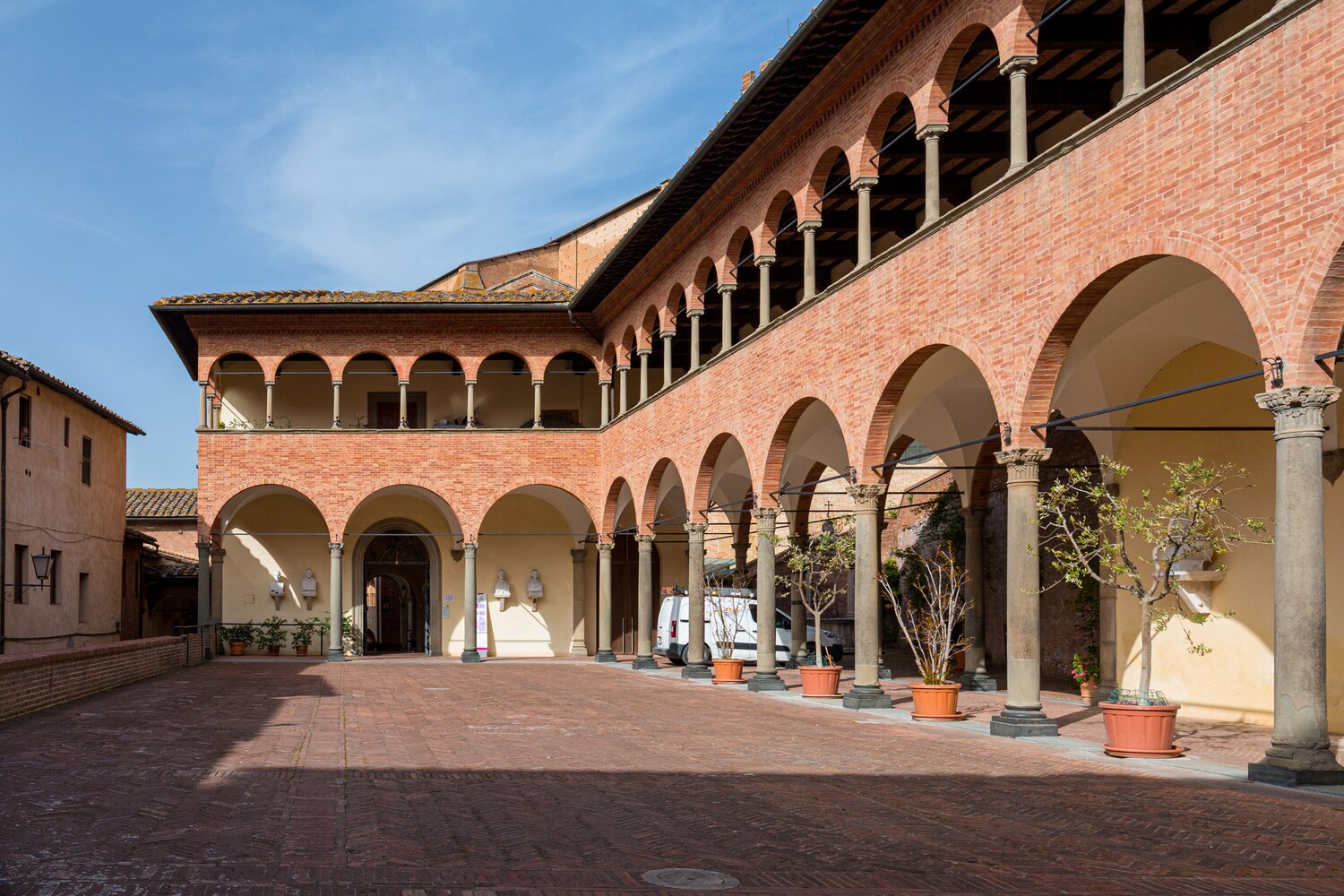
Her city is the place to begin. In Siena you can visit the Basilica of San Domenico, the great brick Dominican church on its hill, where her head is kept in the chapel built to hold it; and, a short walk down, the Sanctuary of St Catherine, the house where she was born, turned into a complex of oratories among the steep lanes of the Fontebranda quarter where her father dyed his cloth. All of it sits within a few minutes of the Piazza del Campo and the striped cathedral, so that a single day in Siena can hold the city and the saint together without hurry. In Rome, her tomb lies under the altar of Santa Maria sopra Minerva, beside the Pantheon — an easy and moving stop on any Roman itinerary, and one most visitors pass without ever knowing who lies there. Seen with her life in mind, the two cities become the two halves of one story, which is exactly the kind of connection our journeys are built to reveal.
Whether you are a pastor planning a trip for your congregation or a family travelling on your own, we build journeys through Christian Italy around understanding — so that a city like Siena becomes the living story of the woman who shaped it, not just a beautiful afternoon. Tell us about your trip and we’ll start planning it with you.
Plan your pilgrimage →Common questions
A Dominican mystic and reformer (1347–1380) from Siena, famous for her Letters and her role in urging the Pope to return from Avignon to Rome. She is a Doctor of the Church, a patron saint of Italy and co-patron of Europe, though she died at only thirty-three.
She nursed plague victims, dictated nearly 400 Letters and the mystical Dialogue of Divine Providence, and intervened in Church politics — pressing Pope Gregory XI to leave Avignon and later defending the Roman pope during the Great Schism. She is also counted among the founders of Italian prose.
Her body lies in Rome, beneath the high altar of the Dominican church of Santa Maria sopra Minerva, near the Pantheon. Her head and a thumb, however, are kept in the Basilica of San Domenico in her home city of Siena.
She died in Rome, which kept her body; Siena wanted its saint back and, by tradition, her followers removed her head and brought it home. The much-loved story that the guards found the bag full of rose petals is legend, not documented fact, but the division of the relics is real.
Yes. Pope Paul VI declared her a Doctor of the Church in 1970, one of the first two women given the title, alongside Teresa of Avila. She was canonised in 1461, named patron of Italy in 1939 (with St Francis), and co-patron of Europe in 1999.
Yes. In Siena you can visit the Basilica of San Domenico, which holds the relic of her head, and the Sanctuary of St Catherine, built around the house where she was born in the Fontebranda quarter — both a short walk from the Piazza del Campo and the cathedral.