Quo Vadis? The Legend on the Appian Way
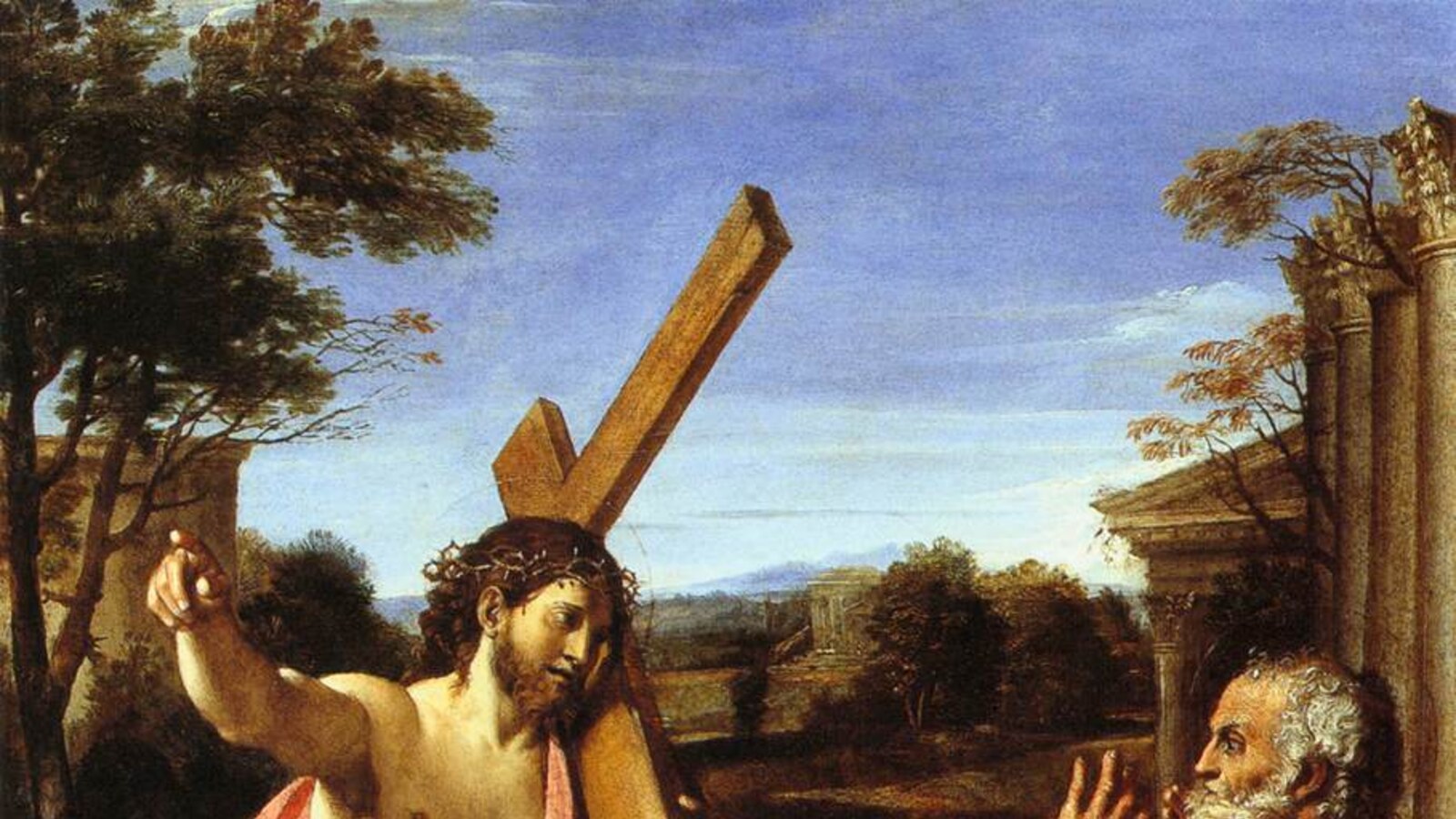
It is one of the most haunting stories in all of Christian tradition, and it unfolds on a road you can still walk today. In the terror of Nero’s persecution, with Christians dying by the hundreds in Rome, the Apostle Peter was persuaded by the faithful to flee the city and save his life — and as he hurried south along the ancient Appian Way in the grey of early morning, he met a man walking the other way, toward the city he was fleeing. It was the Lord himself. Astonished, Peter asked the question that has echoed down twenty centuries: “Domine, quo vadis?” — “Lord, where are you going?” And Jesus answered, “I am going to Rome, to be crucified again.” Peter understood at once. He turned around, walked back into the city he had fled, and gave his life for the faith. It is a story about fear and courage, about the cross that cannot be dodged, and about a God who will not let his friend run away alone. This is the legend of Quo Vadis — where it comes from, what it means, and the little church on the Appian Way that still marks the spot where, the tradition says, it happened.
Rome in the time of Nero
To feel the weight of the story you have to picture the moment. In the year 64 a catastrophic fire destroyed much of Rome, and the emperor Nero, suspected by many of starting it, fixed the blame instead on the city’s small and distrusted community of Christians. What followed was the first great persecution of the Church, and it was savage: Christians were arrested, tortured and put to death in horrifying public spectacles, crucified, burned as living torches to light the emperor’s gardens, thrown to the beasts in the arena. The Roman historian Tacitus, himself no friend of the Christians, recorded the horror with something close to disgust: they were wrapped in the skins of wild beasts and torn apart by dogs, or nailed to crosses, or set alight to serve as lamps when the daylight failed — and such was the savagery, he wrote, that even a hostile public began to feel pity. It is hard, across the comfortable distance of twenty centuries, to feel what it meant to bear the name of Christ in that city in those months. Into this storm the two greatest apostles had come to Rome — Peter, the leader of the Twelve and the first bishop of the city, and Paul, the great missionary — and both would die in it. It was as the net tightened around the Christians of Rome, and around Peter above all, that the small community of believers made a desperate decision: their shepherd must be saved. For the Church in Rome stood, humanly speaking, upon the life of one man; lose Peter, they feared, and the little community that would one day convert an empire might simply vanish into the smoke of Nero’s gardens.
Peter’s flight
The Christians of Rome begged Peter to leave. Their reasoning was sound and loving: if the head of the Church in the capital were killed, the whole flock would be scattered and leaderless, and the faith in Rome might die with him. Better, they pleaded, that he escape to safety and go on guiding the Church from elsewhere. Peter, who was after all a man and not only an apostle, allowed himself to be persuaded, and under cover of darkness he slipped out of the city and set off down the Appian Way, the great road running south from Rome toward the coast. He was, in that moment, doing exactly what any reasonable man would do — saving himself to serve another day. There is no shame in the instinct; it is the instinct of every living creature to flee the fire. But Peter was not every creature, and the road he had chosen for his escape was about to remind him of what he was. And it was precisely then, as he put the danger behind him, that the road gave him the encounter that would change everything.
Domine, quo vadis?
As Peter made his way along the paved road between the tombs, he saw a figure coming toward him, walking calmly into the danger he was escaping. As it drew near he knew it, with a shock, for the Lord — Jesus, risen and radiant, heading straight for the city of death. There was no mistaking him, and no mistaking the direction: everything in Peter’s body was carrying him away from Rome and its crosses, and everything in the figure before him was moving calmly toward them. The old fisherman’s question tumbled out of him, the words that the Church has treasured ever since: “Domine, quo vadis?” — “Lord, where are you going?” And the answer came, gentle and terrible: “Eo Romam iterum crucifigi” — “I am going to Rome to be crucified again.” In that single sentence Peter heard everything. If his Lord was going to Rome to suffer, it could only be because Peter, in fleeing it, was abandoning the cross meant for him; Christ would take it up in his place rather than let it fall. The rebuke was not spoken in anger but in love, and it pierced the apostle to the heart. There is something almost unbearable in the image: the risen Lord, who had already suffered everything, walking willingly back toward a second death simply because his friend had faltered. It said, more powerfully than any sermon could, that the cross is never optional for those who would follow him, and that the only one who can carry Peter’s cross for him is Christ — who would rather die again than see him lose his crown.
“Lord, where are you going?” “I am going to Rome, to be crucified again.”The Acts of Peter
The turning back
The vision faded, and Peter stood alone on the empty road with his choice before him. He did not hesitate. Ashamed of his flight and strengthened by what he had seen, he turned on his heel and walked back the way he had come, back through the gates and into the lion’s mouth of Nero’s Rome, to meet the death he had tried to escape. He was arrested, and condemned to be crucified; and here the tradition records his last act of humility, that Peter asked to be crucified head downward, declaring himself unworthy to die in the same manner as his Lord. He was buried on the Vatican hill, and over his grave there rises today the greatest church in Christendom. It is one of the quiet symmetries of the story that the man who would not at first face a cross came in the end to ask for a harder one, and that the place of his execution, a desolate circus outside the city walls, became through his death the very centre of the Christian world. The meaning of the legend is as plain as it is demanding: there is a cross that each must carry, and no running from it; the moment of turning back on the Appian Way is the moment a frightened man became, at last, the rock on which the Church was built.
The echo of an earlier fall
Part of what makes the Quo Vadis story so piercing is that it was not the first time Peter had run. On the night Jesus was arrested, the same Peter who had sworn he would die at his master’s side instead denied him three times, to a servant girl and to the bystanders warming themselves at a courtyard fire, swearing that he did not even know the man — and when the cock crowed he went out and wept bitterly. The flight down the Appian Way is, in a sense, that failure returning: once again fear has the upper hand, once again Peter is saving himself. And once again the Lord comes to meet him, not with condemnation but with the offer of a second chance. Where the first denial ended in tears beside a fire, this second flight ends in a turning-back on an open road — and this time Peter does not fail. It is one of the most human patterns in all of Scripture and tradition, the good man who falls, and falls again, and is lifted up each time, and it is why Peter, of all the saints, has always been the particular friend of the weak and the frightened. He is not the hero who never wavered. He is the one who wavered, and was forgiven, and in the end gave everything he had. That, in truth, is why the Quo Vadis story has been loved so tenderly for so long. It is not a tale of a plaster saint but of a real and fallible man, the kind of man most of us actually are, who was afraid and ran, was met on the road by a love that would not give up on him, and found in that meeting the strength to become what he had been called to be. Each of us has our own stretch of the Appian Way, and our own moment of choosing whether to keep walking away or to turn around; and the little church on the road stands there, still, to remind us that the choice is always open.
Where the story comes from
It is worth being clear about what kind of story this is. The meeting on the Appian Way is not found in the Bible; it comes to us from the Acts of Peter, an early Christian text from around the second century — not part of Scripture, but ancient, widely loved, and preserving traditions about the apostle’s last days that the Church has cherished for nearly two thousand years. It is, in the truest sense, a legend: a holy story told to carry a truth, whether or not it records an event exactly as it happened. And what a truth it carries. Down the centuries the scene has spoken to every Christian tempted to take the easy road, and it has inspired art and literature without end — most famously the great novel Quo Vadis by the Polish writer Henryk Sienkiewicz, published in 1896, which told the story of Nero’s Rome and Peter’s return to a vast worldwide readership, helped win its author the Nobel Prize, and has been filmed again and again. Few three-word questions in history have echoed so far. Sienkiewicz’s novel became one of the best-selling books of its age and was turned into a lavish Hollywood epic in 1951, with its unforgettable mad Nero; and the phrase quo vadis has long since escaped the Church altogether, used wherever someone wants to ask, gravely, where a person or a people is truly heading. That a question whispered on a Roman road to a frightened fisherman should have travelled so far, and lodged so deep, is itself a kind of proof of the story’s strange and lasting power.
The Church of Domine Quo Vadis
The spot where the tradition places the encounter is marked, as such places in Italy always are, by a church — and a very small and moving one. A short way out along the Appian Way, just beyond the old Porta San Sebastiano where the road leaves the city, stands the little church properly called Santa Maria in Palmis, but known to everyone simply as the Chiesa del Domine Quo Vadis. It is a humble, plain building, easily missed, and that is part of its power. Inside, set into the floor, is a marble slab bearing what tradition calls the footprints of Christ — the marks, the faithful say, left by the Lord’s feet as he stood on the road before Peter; the name in Palmis itself refers to the soles of those feet. The slab in the church is a copy, kept for the pilgrims; the stone venerated as the original is preserved nearby in the Basilica of San Sebastiano. Whatever one makes of the footprints, to stand in that little church, on the very road, and read the story on the wall is to feel the old legend become suddenly and almost unbearably close. The church has stood here in some form since the Middle Ages, rebuilt in its present modest shape in the seventeenth century, and near the door a plaque honours Henryk Sienkiewicz, who is said to have first conceived his great novel while sitting quietly in this very place. It is not a grand building, and it does not try to be; it simply keeps the memory of a moment, on the exact patch of road where the memory belongs — which is, in the end, far more affecting than any marble could be.
Walking the Appian Way
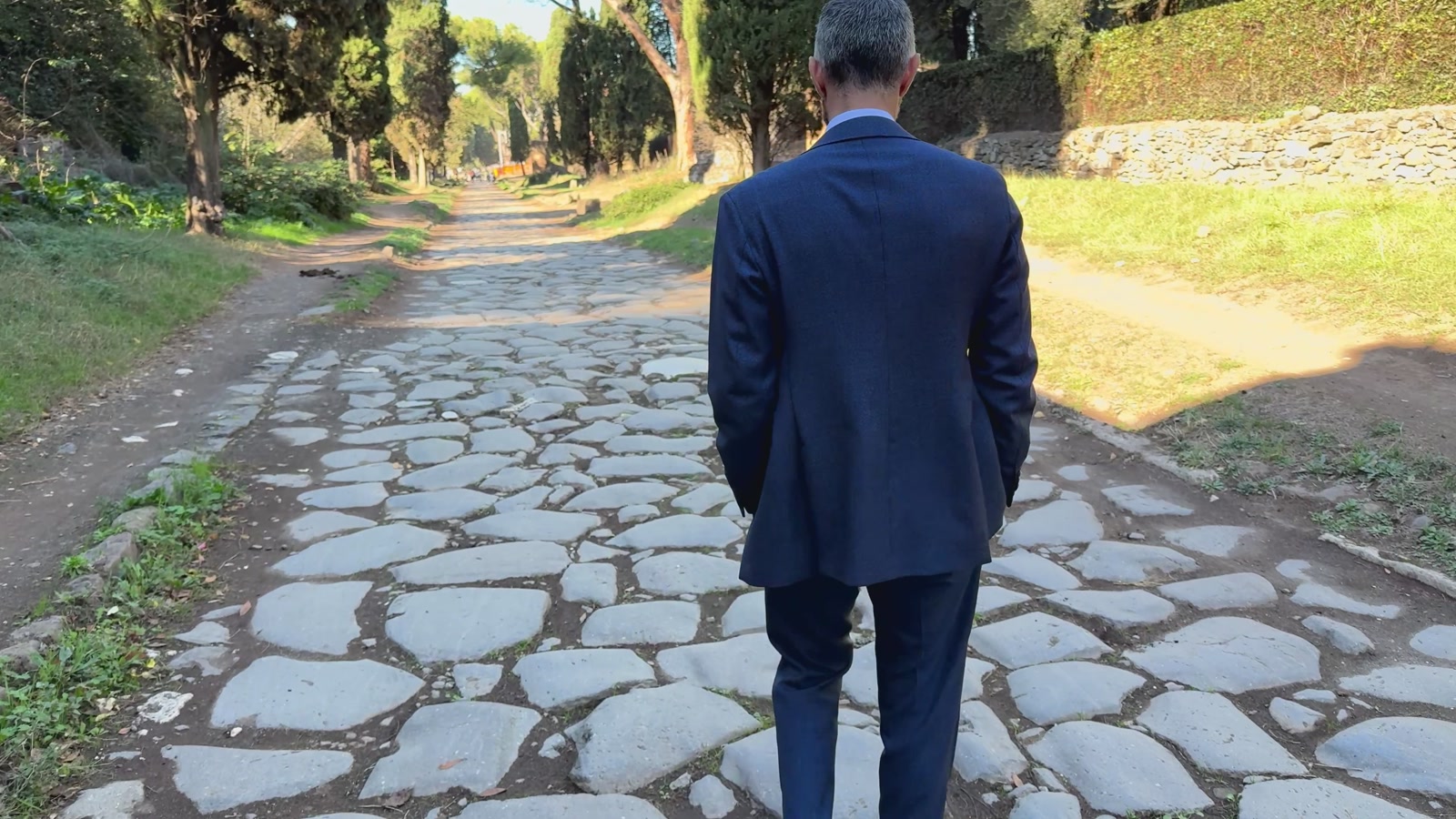
The road itself is the greater pilgrimage. The Appian Way — the Via Appia Antica, begun more than three hundred years before Christ and called by the Romans the Regina Viarum, the queen of roads — runs out of Rome straight and ancient between umbrella pines and the broken tombs of the pagan dead, and no road on earth is more soaked in the story of early Christianity. It was along this very road that the Apostle Paul was led into Rome as a prisoner; beneath it lie the great catacombs of San Callisto and San Sebastiano, where the first Christians buried their dead and hid in times of terror; and upon it, the tradition says, Peter met his Lord and turned back to die. To walk a stretch of the Appian Way on foot — past the tombs, over the original Roman paving stones worn smooth by two thousand years, pausing at the little church of Quo Vadis — is to walk the single most evocative mile in all of Christian Rome, where the question asked on that road long ago still seems to hang in the air: where are you going? Better still, time your walk for the early morning or a quiet weekday — much of the Appian Way is now a protected archaeological park, closed to cars on Sundays — when the noise of the modern city falls away and the road belongs again to the pines, the ruined tombs and the silence. Walk it then, and you begin to understand why the first Christians thought of this ground as holy. Peter walked out along it in fear and walked back along it in faith; and every pilgrim who follows his steps is, in some small way, being asked the same question, and answering it, for themselves.
Whether you are a pastor planning a journey for your congregation or a traveller going on your own, we build trips through Christian Italy around understanding — so that a walk down the Appian Way, past the little church of Quo Vadis, becomes the living close of Peter’s story rather than a stop on a tour. Tell us about your trip and we’ll start planning it with you.
Plan your pilgrimage →Common questions
“Quo vadis?” is Latin for “Where are you going?” It comes from the question St Peter is said to have asked the risen Christ on the Appian Way: “Domine, quo vadis?” — “Lord, where are you going?” The phrase has become one of the most famous in Christian tradition.
According to tradition, during Nero’s persecution St Peter fled Rome to save his life. On the Appian Way he met the risen Jesus walking toward the city and asked where he was going; Jesus replied that he was going to Rome to be crucified again. Understanding the rebuke, Peter turned back and accepted his own martyrdom.
No. The meeting on the Appian Way is not in Scripture. It comes from the Acts of Peter, an early Christian text of about the second century, and is an ancient and cherished tradition rather than a biblical account. It has shaped Christian devotion and art for nearly two thousand years.
On the Appian Way just outside the old Porta San Sebastiano in Rome, a short way beyond the city walls. Properly called Santa Maria in Palmis, the small church marks the traditional spot of Peter’s encounter and contains a marble slab said to bear the footprints of Christ (a copy; the original is in the nearby Basilica of San Sebastiano).
Tradition holds that after turning back to Rome, Peter was arrested and crucified during Nero’s persecution, around the mid-60s AD. He is said to have asked to be crucified head downward, feeling unworthy to die as Christ had. He was buried on the Vatican hill, where St Peter’s Basilica now stands over his tomb.
Yes. The Via Appia Antica is a protected archaeological park, and you can walk long stretches of the original Roman road past ancient tombs, the catacombs and the church of Quo Vadis. It is one of the most atmospheric and moving walks in all of Christian Rome.