St Anthony of Padua: the Finder of Lost Things
Almost everyone has whispered his name over a lost set of keys — Saint Anthony, Saint Anthony, please come around — and almost everyone has the man entirely wrong. He is the most familiar saint in the Catholic world, the gentle figure in a brown habit cradling the Christ Child and a lily, the one you turn to for a mislaid phone or a missing earring; and nearly every part of that picture conceals the reality. Anthony of Padua was not Italian but Portuguese, was not born Anthony, and was not from Padua. He was a brilliant and ferocious young preacher, a nobleman turned friar who set out to die a martyr and was saved, against his own wishes, by a shipwreck; who held open fields of thousands spellbound; who was raised to the altars within a single year of his death, one of the swiftest canonisations the Church has ever pronounced; and whose tongue, alone of his whole body, was found fresh and red three decades in the grave, and is still shown in Padua today. The cosy patron of lost objects was, in his own lifetime, one of the most formidable voices in Christendom.
For a traveller, that distance between the holy card and the truth is the whole invitation. To arrive in Padua knowing who Anthony actually was is to turn one of the busiest shrines on earth from a crowd you shuffle through into a story you stand inside — which is precisely why, on this site, we prepare people to understand a place before they reach it rather than merely to look at it: pilgrimage, not tourism.
Fernando of Lisbon, and the martyrs who sent him to Italy
He was born in Lisbon around 1195, into a prosperous family, and baptised Fernando Martins de Bulhoes. As a young man he entered the Augustinian canons and buried himself in study, absorbing the Scripture and theology that would one day make him one of the great preachers of the age; nothing in those quiet years pointed toward Italy, or toward the brown habit the world now pictures him in. The turning came from far away, and it came from blood. In 1220 the bodies of five Franciscan friars — murdered while preaching in Morocco, the first martyrs of the young order founded by St Francis of Assisi — were carried home to Portugal, and the sight of them set the young canon alight. He left the Augustinians, joined the Franciscans, took the name Anthony, and sailed for Morocco determined to win the same martyr’s crown. He never came near it. Illness laid him low almost as soon as he landed and forced him to turn back, and the ship bearing him home was caught by a storm and wrecked on the coast of Sicily. That accident of weather is the only reason there is a Saint Anthony of Padua at all: it set him down, by chance, in Italy, and Italy would never give him back.
The hidden preacher
For a while the shipwrecked foreigner passed unnoticed, a frail friar handed the humblest chores, until a day at Forli when the appointed speaker failed to appear and Anthony, almost as an afterthought, was told to say a few words to fill the silence. What came out of him silenced the room instead. The depth of his learning, his uncanny memory for Scripture and his sheer power as a speaker were a revelation, and from that moment the Franciscans turned him loose on the roads of northern Italy and southern France as their greatest preacher. He drew crowds far too large for any church, so that he spoke in open fields and market squares with shops shut early and whole towns emptying to hear him; he dismantled the arguments of the Cathar heretics so relentlessly that he was nicknamed the “Hammer of the Heretics”; and his command of theology was so complete that the Church would in time enrol him among its official teachers, naming him a Doctor of the Church — the Evangelical Doctor — in 1946. It is worth holding that beside the holy card: the saint of lost umbrellas was, to his own century, a man whose words could move cities, and whose arrival in a town was an event people walked for days to reach.
The man the world remembers for finding lost keys was, in his own time, one of the most powerful voices in Christendom.
The Child, the lily, and the wonders told of him
The tender image is not an invention either; its roots run deep into his legend. Anthony is almost always shown cradling the infant Jesus, usually with a white lily and a book, from a tradition that a host once glimpsed him at night with the Christ Child resting in his arms, wrapped in light. The lily came to stand for his purity, the book for his mastery of the Scriptures, and the Child for the nearness to God that his contemporaries believed they could see in him. The gentleness was real. It was simply never the whole of him, and around it the medieval imagination wove a whole garland of marvels that are worth knowing precisely because of what they were trying to say.
The honest traveller enjoys these for what they are — beloved legend rather than documented history — while hearing the point underneath them. It is told that when the heretics of Rimini stopped their ears against him, Anthony turned and preached instead to the fish, which rose in ranks to the surface of the water to listen; that a sceptic’s hungry mule, offered a bucket of oats on one side and the Blessed Sacrament on the other, knelt down before the Sacrament and would not eat; that when a miser was buried, Anthony sent the family to open the dead man’s strongbox, where his heart was found lying among the coins, for where a man’s treasure is, there his heart will be; and that he once restored a severed foot to a young man who had kicked his own mother and repented of it. Strip away the embroidery and the message is always the same — here was a man whose words bent the stubborn and the proud — and it was that reputation, far more than any single wonder, which filled the roads to hear him in life and the roads to his tomb after it.
Death at thirty-five, and a saint within the year
The pace destroyed him. Burnt out by relentless preaching and chronic ill health, Anthony died young, on 13 June 1231, at Arcella just outside Padua — the city where he had settled and preached his last, overwhelming Lenten sermons to packed squares. He was about thirty-five. What followed is almost without parallel in the history of the Church: the people of Padua clamoured for his sainthood so insistently, and the miracles reported at his grave came so thick and fast, that Pope Gregory IX canonised him on 30 May 1232 — less than a year after his death, among the swiftest canonisations ever made. Padua set to work at once on the vast basilica that still bears, with the confidence of a city that needs no surname for him, the single name Il Santo: The Saint. Nearly eight centuries later, the crowds have never stopped coming.
The incorrupt tongue
The relic that fixes him in the memory asks for the plain telling we give these things. In 1263, more than thirty years after his death, his tomb was opened and his remains moved into a new coffin under the direction of St Bonaventure, then the head of the whole Franciscan order. The body itself had done what bodies do; it had fallen to bone. But his tongue, by the testimony of those who stood there, was found still red, moist and whole, as though it had never ceased to speak — and to his brothers the meaning was overwhelming, for the one part of this man spared corruption was the very organ with which he had carried the Gospel across two countries. That tongue, together with his jaw and vocal cords, is kept to this day in a golden reliquary in the Chapel of the Relics inside the basilica, and venerated each February in the feast the Paduans call, simply, the Feast of the Tongue. Be clear on the thing the souvenir stalls blur: Anthony’s body is not incorrupt. What endured, and what you go to Padua to see, is the tongue alone — a stranger and far more pointed sign than any untouched body could ever have been.
How a preacher became the patron of lost things
How, then, did a learned and thunderous preacher dwindle, in the popular mind, into the saint you petition for a missing phone? The devotion grew from an episode in his own life: a novice who had decided to abandon the order ran off with the book of psalms Anthony used for teaching — a costly, hand-copied thing in an age before printing — and Anthony prayed hard for its return, upon which the runaway, seized by a frightening vision, came back and surrendered it. From that single lost-and-found the centuries spun a universal reflex, until “praying to St Anthony” became shorthand, across the whole Catholic world, for recovering anything mislaid. It is, strictly, a popular devotion rather than any formal office of the Church, but it is a revealing one, because the same tender practicality made him the patron of the poor: the charity still called “St Anthony’s Bread,” given in thanks for his help, feeds the hungry in his name to this day. A saint of small daily troubles and of real hunger at once — which may be exactly why, in eight hundred years, he has never once gone out of fashion.
Padua: the Saint, and the city around him
Anthony is a lesson in how much a familiar saint can hide, and in why it is worth the trouble to look past the holy card. Strip that away and you find a Portuguese nobleman turned friar, a would-be martyr saved against his will by a shipwreck, a preacher who shook two countries and was raised to the altars in a single year, and a relic — one incorrupt tongue — stranger than any of his legends. To stand in Padua holding all of that at once is to feel the thread we keep following on this site: the long, unbroken, intensely human history of the faith, carried from century to century by individuals of startling force, running without a break from their time into ours. It is the same clear sight we bring to St Catherine of Siena, to Padre Pio, and to the Shroud of Turin: arrive understanding, and a shrine stops being a queue to endure and becomes a life to meet.
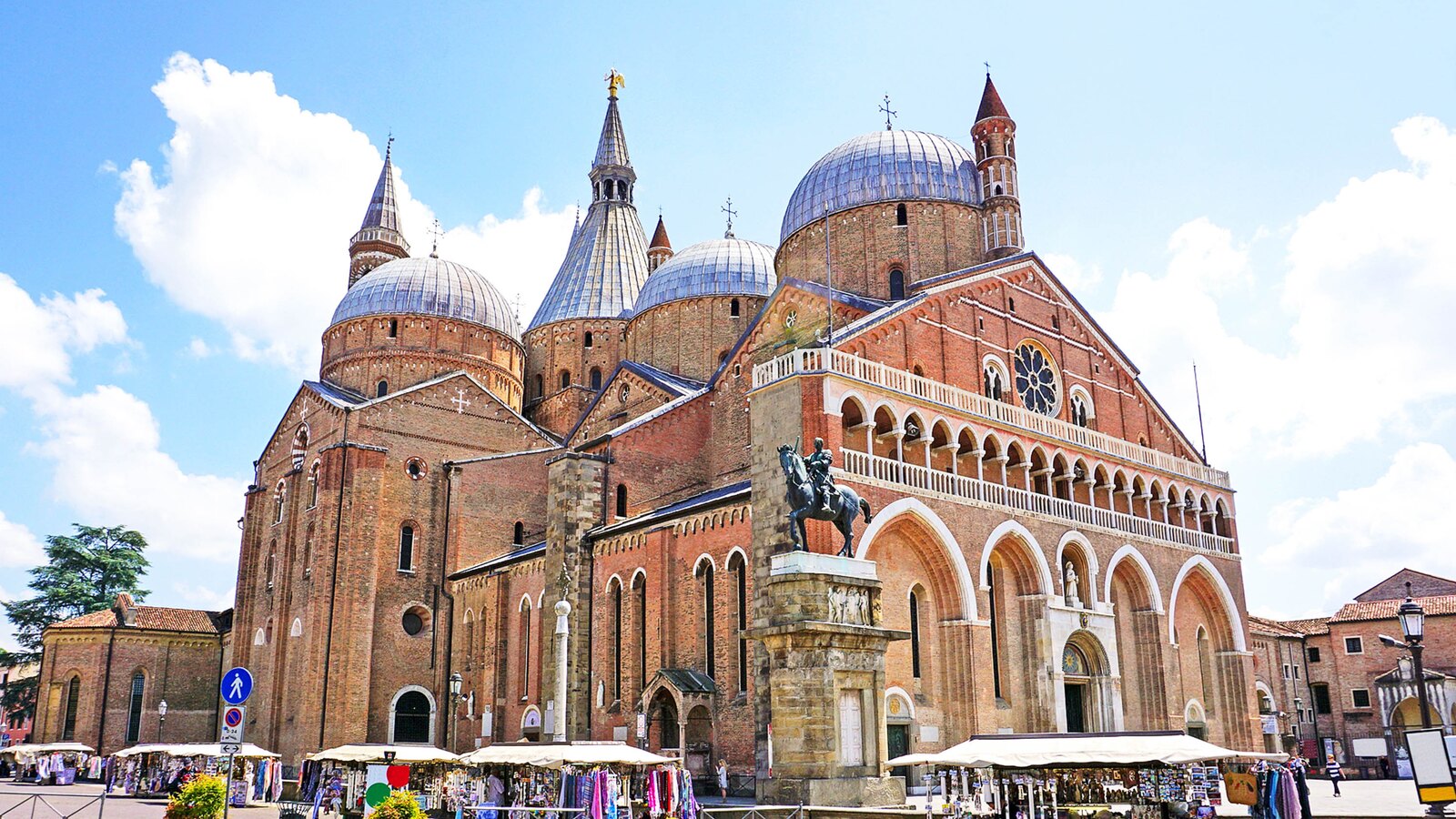
His city makes that easy, and generous. Padua, in the Veneto and only a short train ride west of Venice, is one of the great pilgrimage centres of Italy and, at the same time, one of its most rewarding and least crowded towns of art. At its heart stands the Basilica of St Anthony, a startling eastern skyline of domes and slender towers, where you can pray at his tomb, follow the sequence of marble reliefs that recount his miracles, and see the preserved tongue glowing in the Chapel of the Relics; in the square outside rises Donatello’s bronze warrior on his horse, the Gattamelata, a cornerstone of Renaissance sculpture. And Padua gives far more than the Saint alone: a few minutes’ walk away, the Scrovegni Chapel holds the frescoes with which Giotto changed the direction of Western painting, and the city’s university is among the oldest on earth. A single day here can carry the saint, the art and the city in one unhurried arc — precisely the kind of layered journey we build for travellers who would rather understand what they are looking at than simply tick it off a list.
Whether you are a pastor planning a trip for your congregation or a family travelling on your own, we build journeys through Christian Italy around understanding — so that a basilica like Padua’s becomes the real story of the man inside it, not just a crowded stop. Tell us about your trip and we’ll start planning it with you.
Plan your pilgrimage →Common questions
A Portuguese-born Franciscan friar (1195–1231), baptised Fernando in Lisbon, who became one of the most famous preachers of the Middle Ages. He died near Padua at about thirty-five, was canonised within a year, and is a Doctor of the Church and the popular patron of lost things.
From a story in his own life: a novice took a book Anthony used for teaching, Anthony prayed for its return, and the thief brought it back. From that lost-and-found grew the worldwide habit of praying to St Anthony to recover anything mislaid — a popular devotion rather than a formal Church title.
No — his body decayed to bone. But when his tomb was opened in 1263, his tongue was found whole and fresh, and it is kept to this day in a golden reliquary in the Basilica of St Anthony in Padua, together with his jaw. It is the tongue, not the body, that was preserved.
No. He was born in Lisbon, Portugal, and was originally an Augustinian canon named Fernando. He became a Franciscan, took the name Anthony, and only reached Italy after a storm wrecked his ship in Sicily. He settled and died near Padua, which gave him his name.
In the Basilica of St Anthony — Il Santo — in Padua, in the Veneto, a short train ride from Venice. You can pray at his tomb and see his preserved tongue in the Chapel of the Relics. It is one of the most visited shrines in the Catholic world, open to all.
13 June, the day he died in 1231. In Padua a second feast, the Feast of the Tongue, is kept in February to mark the 1263 discovery of his incorrupt tongue. His basilica draws pilgrims throughout the year, and especially around his June feast.