St Rita of Cascia: the Saint of Impossible Causes
She is the saint people turn to when there is nothing left to try — the patron of impossible causes, of lost situations and hopeless marriages, invoked by millions who have run out of other doors to knock on. What is less often told is why that patronage fits her so exactly: Rita of Cascia’s own life was a catalogue of the impossible. She was married young, against her will, to a violent man in a mountain world ruled by the blood-feud; she saw her husband murdered and her two sons swear vengeance; she buried both of them; she was turned away from the convent she longed for; and when at last she became a nun she spent fifteen years bearing a single wound on her forehead, said to be a thorn from the crown of Christ. She died in 1457 in the Umbrian hills, and her body lies there still, in the town of Cascia, venerated as incorrupt five and a half centuries later.
Hers is not a comfortable story, and we would not tell it as one. It is, instead, one of the most human lives in the whole calendar of saints — which is exactly why it rewards a traveller who arrives understanding it, rather than one who merely passes a glass case in a mountain basilica.
A marriage she did not choose
Rita — Margherita Lotti — was born around 1381 in Roccaporena, a hamlet of grey stone clinging to the mountainside a few miles from Cascia, in the high, remote Apennines of Umbria, east of Spoleto. She is said to have wanted the religious life from childhood, but in her world a girl’s wishes counted for very little, and her parents promised her in marriage while she was still a child, to a man named Paolo Mancini. The accounts of him vary, and honesty requires saying so: some portray him as harsh and hot-tempered, a hard man to be bound to, while gentler versions stress that Rita’s patience slowly softened and converted him. What none of them disguise is the texture of the world she married into — the fierce, feud-ridden society of the medieval Umbrian mountains, where families carried grudges down the generations and settled them in blood. She bore two sons and kept a household inside that world for many years, and by every account she kept it with a steadiness that those around her remembered.
Murder, and a mother’s terrible prayer
Then the feud reached her door. Paolo was ambushed and killed — a death out of the very cycle of vendetta that poisoned the region — and in that place and time a widow’s sons were expected to answer murder with murder. Rita’s two boys swore to avenge their father. Here the tradition hands us one of the most wrenching acts attributed to any saint: rather than see her sons damn their souls by killing, Rita is said to have prayed that God would take them first. Both young men fell ill and died not long after, before they could carry out the revenge. Read it however you will — as a mother’s unbearable choice, or as a story the centuries sharpened — it is the dark hinge of her life, and the reason she speaks so directly to anyone caught in a situation with no good way out. She had forgiven her husband’s killers; she had lost her whole family; and she was, at a stroke, utterly alone.
The convent that first turned her away
Widowed and childless, Rita turned back to the longing of her girlhood and asked to enter the Augustinian convent of Saint Mary Magdalene in Cascia. She was refused. The reasons given by tradition are revealing: partly that the house took only virgins, not widows, and partly that she was entangled, through her murdered husband, in the very feud the sisters wished to keep outside their walls. By tradition she would not take no for an answer and worked first to make peace between the warring families, and only then — at around the age of thirty-six — was she finally admitted. It is a small, stubborn detail that says a great deal about her: the patron of impossible causes began her religious life by refusing to accept an impossible no.
The thorn
Rita lived out the rest of her years as an Augustinian in Cascia, in prayer, penance and the care of the sick, and it was there, in about her last fifteen years, that the mark came for which she is most venerated. While praying before a crucifix, by the tradition of her order, she felt a single thorn detach itself from the carved crown of thorns and pierce her forehead, leaving an open wound that never healed. It was not the full stigmata of Padre Pio or the five wounds of other mystics but a single, partial sign — and a hard one to live with, for the wound is said to have festered and given off such an odour that she was kept largely apart from the others. There is something characteristic in that. Even her mark of holiness was not a glory to be shown but a burden to be borne in near-solitude, of a piece with a life that had asked her to carry one unbearable thing after another.
The rose out of season
The gentlest of her stories comes at the very end. By tradition Rita, old and failing in the depth of winter, asked a visitor from Roccaporena to bring her a rose from the garden of her old family home — and though it was no season for roses, a single bloom was found open on the bare bush and carried to her bedside. From that comes her enduring emblem, the rose, and the custom of blessing roses in her name on her feast day; the women of Cascia still speak, too, of white bees that have lived in the convent wall since her lifetime. Rita died on 22 May 1457, in her seventies, and the small mountain town set about keeping her memory with a devotion that has never faded. Her feast is still 22 May, and to this day the churches fill with people carrying roses to be blessed in her name.
Incorrupt, and the saint of the impossible
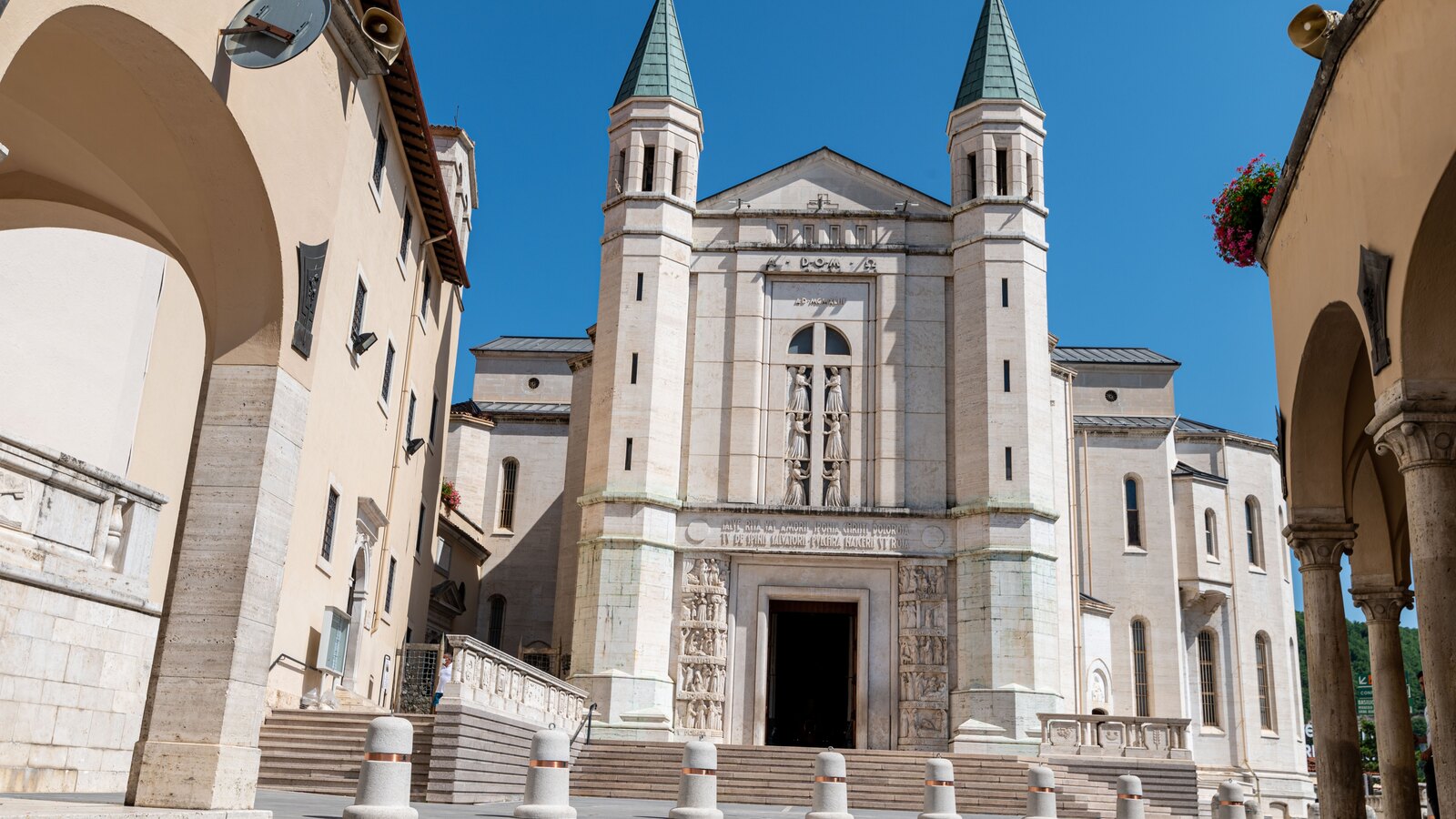
When her tomb was opened her body was found whole, undecayed, and it has been venerated as incorrupt ever since — one of a small number of such bodies in Italy, and, unlike some relics we have been careful to correct elsewhere, a genuine case of a preserved body on open display rather than a reconstruction. She lies today in a crystal urn in the great twentieth-century Basilica of Santa Rita at Cascia, her face serene behind the glass. The Church, which treats such preservation as a sign to ponder rather than a doctrine to enforce, moved slowly in her cause: she was beatified by Pope Urban VIII in 1627, and only canonised on 24 May 1900 by Pope Leo XIII. By then the people had long since made their own verdict. Because her life had held every kind of hopeless situation — a bad marriage, a violent death, the loss of children, rejection, long suffering — and she had come through all of it to holiness, she became, in the devotion of ordinary people, the Santa degli impossibili, the saint of the impossible, the one you ask when every human remedy has failed.
She is the patron of impossible causes because her own life was a catalogue of them.
Why she belongs on a pilgrimage to Italy
Rita is the saint who makes the others legible to anyone who has ever simply suffered. Where St Catherine of Siena moved popes and St Anthony of Padua shook cities, Rita kept a household, forgave a murder, buried her children and endured — and that, to the millions who come to Cascia, is a different and nearer kind of greatness. To stand in her basilica knowing her story is to understand something a beautiful building alone cannot say: that the faith which shaped this country was carried not only by the powerful and the learned but by women in remote mountain villages whose sanctity was made out of ordinary, brutal hardship, and that the thread runs through them, unbroken, to us. That is the whole of what we prepare travellers to recognise, so that a shrine stops being a photograph and becomes a life you can almost reach — pilgrimage, not tourism.
Visiting Cascia and Roccaporena
Rita’s country is one of the quietest and most beautiful corners of Italy, high in the Apennines of eastern Umbria, not far from Norcia and Spoleto and within reach of Assisi. In Cascia itself the Basilica of Santa Rita, a large and luminous shrine built in the first half of the twentieth century, holds her incorrupt body and draws pilgrims from across the world, most of all around her May feast, when the town fills with roses. A short way up the valley lies Roccaporena, the tiny stone village where she was born and married, its houses gathered beneath a great rock crowned with a small chapel — a place that has changed remarkably little since her day and that gives, better than any museum, the feel of the hard mountain world she came from. Seen together, the grand basilica and the humble village tell the whole of her in a single afternoon: the ordinary woman and the saint of the impossible, a few miles and five centuries apart. It is exactly the kind of connection our journeys are built to reveal.
Whether you are a pastor planning a trip for your congregation or a family travelling on your own, we build journeys through Christian Italy around understanding — so that a place like Cascia becomes the real story of the woman who suffered and prayed there, not just a stop on a map. Tell us about your trip and we’ll start planning it with you.
Plan your pilgrimage →Common questions
An Italian wife, mother, widow and finally Augustinian nun (c. 1381–1457) from the mountains of Umbria. After a hard marriage, her husband’s murder and the loss of her sons, she entered a convent at Cascia and bore a thorn-wound on her forehead for years. She is venerated as the patron of impossible causes.
Because her own life was full of hopeless situations — a forced, violent marriage, her husband killed in a feud, both her sons dead, rejection by the convent — and she came through all of it to holiness. People who have run out of every human remedy pray to her as the “saint of the impossible.”
Her body was found undecayed after her death and has been venerated as incorrupt ever since. Unlike some relics presented as reconstructions, it is a genuine preserved body, displayed in a crystal urn in the Basilica of Santa Rita at Cascia. The Church treats such incorruption as a sign, not a required doctrine.
By tradition, while praying before a crucifix Rita received a single wound on her forehead, as though pierced by one thorn from Christ’s crown. It was a partial stigma, not the full five wounds, and she is said to have borne it, painful and slow to heal, for about the last fifteen years of her life.
She was beatified by Pope Urban VIII in 1627 and canonised by Pope Leo XIII on 24 May 1900. Her feast day is 22 May, when roses are traditionally blessed in her name — the rose being her emblem, from the winter bloom brought to her deathbed.
In the Basilica of Santa Rita at Cascia, in the Apennines of eastern Umbria, near Norcia and within reach of Assisi. Her incorrupt body is on display there. Nearby is Roccaporena, the mountain village where she was born and married, which can still be visited today.